
The Tri-State Zoological Park of Western Maryland (“Tri-State”) has appealed a Maryland Federal District Court Order to the U.S. Supreme Court.[1] The District Court Order, issued by U.S. District Court Judge Paula Xinis, found extensive violations of the Endangered Species Act (“ESA”) and forced Tri-State to cease all zoo operations and to immediately surrender all surviving endangered animals.[2] Tri-State has argued in its petition for certiorari to the Supreme Court that the People for the Ethical Treatment of Animals (“PETA”) lacks organizational standing to sue the zoo under the ESA.[3] Two lemurs, two lions, and five tigers are the surviving endangered species at the center of the ongoing litigation.[4]
While the legal issues before the Supreme Court are far removed from the treatment of the animals at Tri-State, the District Court found overwhelming evidence that Tri-State and its owner Robert Candy had grossly violated the ESA and federal law.[5] Judge Xinis stated that “[f]ilth and feces dominate Tri-State” and that the zoo’s grounds resembled a “bacteria-ridden wasteland” where the animals were subjected to “fetid and dystopic conditions.”[6] The animals, food and water were intermingled with waste throughout the zoo; from the kitchens, to the animals’ own enclosures.[7] Tri-State’s staff made no efforts to clean the grounds.[8] No cleaning areas, no cleaning receptacles, or any standard cleaning facilities for zoos or animal sanctuaries were found at Tri-State.[9]
A veterinarian for Tri-State, Dr. Gale Duncan, had no experience treating or caring for exotic animals like lemurs or big cats.[10] “I’m just a regular old veterinarian…” stated Dr. Duncan during deposition testimony.[11] Despite many of the animals’ chronic health conditions, Dr. Duncan failed to maintain sufficient documentation of their illnesses.[12] None of the big cats even received common vaccinations, to which Tri-State’s veterinary staff claimed “self-preservation” and “giving a tiger a shot, that’s difficult.”[13]
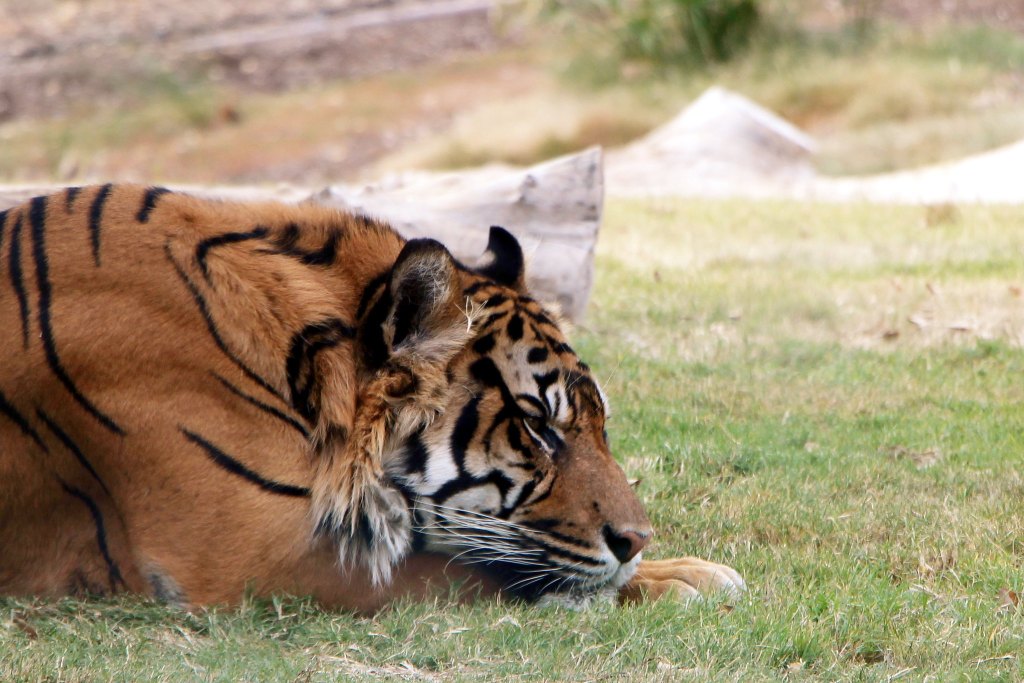
Tri-State’s grounds and lack of veterinary care was not the only evidence.[14] Some of the most compelling evidence was the complete lack of social or environmental enrichment for the animals.[15] The ring-tailed lemurs, which live in moderately sized groups in Madagascar, were forced to live portions of their lives alone in near bare enclosures at Tri-State.[16] The lions, which live in prides of forty or more in the wild, were each kept in solitude in similar barren conditions for more than eight years.[17] One of the lion’s enclosures contained nothing but a single ball as a source of engagement.[18] Expert testimony at trial noted that providing a lion with a single ball for company “is tantamount to confining a human in a single room with a single book for years on end.”[19] The five tigers, which are normally solitary animals in the wild, were inexplicably forced to share living space in an empty concrete swimming pool.[20] Like the lion enclosures, the tigers’ “concrete jungles” contained nothing but a few bowling balls.[21]
The District Court found in favor of PETA and ordered an injunction against Tri-State from continuing its operations.[22] The court further ordered Tri-State to immediately transfer the surviving animals to the Wild Animal Sanctuary in Colorado.[23] Tri-State appealed to the Fourth Circuit and argued that PETA lacked standing to bring the lawsuit. [24] The Fourth Circuit disagreed and held that PETA’s “diversion of resources” to “submit complaints about Defendants…[to] compile and publish information about Tri-State’s treatment of its animals…[and to] investigate and monitor Defendants” impeded PETA’s efforts to carry out its mission to protect animals and thus established an injury in-fact and PETA’s organizational standing to sue Tri-State under the ESA. [25]
The question now submitted to the Supreme Court is whether PETA has standing to sue Tri-State under the ESA by only showing that its mission was impeded by Tri-State, and that it diverted resources to stop Tri-State’s ongoing violations of federal law.[26] Tri-State has argued in its petition for certiorari the Federal District Courts, have misinterpreted Supreme Court precedent which allows organizations to have standing where a defendant’s misconduct “causes injury by frustrating the organizational mission, thus requiring the organization to divert resources in response.”[27] Overall, Tri-State’s argument is simple – PETA’s mission to rescue endangered animals could not be impeded by Tri-State because PETA’s mission was to rescue the endangered animals from Tri-State.[28]
Tri-State’s petition has been docketed, but the Supreme Court has not yet indicated if it will hear the case.[29] While the legal issues are distant from the treatment of the animals from Tri-State, one cannot help but wonder – if the Supreme Court strikes down organizational standing, who will be able, or willing, to sue Tri-State to enforce the ESA? If the Supreme Court reviews the case, and finds in favor of Tri-State, interest group organizations from PETA to the NRA will no longer be able to claim a frustration of an organizational mission and a diversion of resources as grounds to establish organizational standing.

Curtis Paul is a third-year day student at the University of Baltimore School of Law and a Staff Editor for Law Forum. Curtis graduated from UMBC in May 2016 with a degree in philosophy. Since then, Curtis has been active in the UB Law community and has interned for multiple Federal bodies including the Department of Justice this upcoming Spring. Curtis will graduate in May 2021 and will clerk for the Honorable Stuart R. Berger on the Maryland Court of Special Appeals after graduation.
[1] Steve Lash, “Cumberland Zoo Appeals Pro-PETA ruling to the Supreme Court”, The Daily Record (Mar. 5, 2021), https://thedailyrecord-com.proxy-bl.researchport.umd.edu/2021/03/05/cumberland-zoo-appeals-pro-peta-ruling-to-supreme-court/.
[2] Id.
[3] Brief for Petitioner, Tri-State Zoological Park of Western Maryland, Inc., et al., v. People for the Ethical Treatment OF Animals, Inc., (2021) (No. 20-1183).
[4] People for Ethical Treatment of Animals, Inc. v. Tri-State Zoological Park of W. Maryland, Inc., 424 F. Supp. 3d 404, 408 (D. Md. 2019).
[5] Id.
[6] Id.
[7] Id.
[8] Id.
[9] Id.
[10] Tri-State, 424 F. Supp. 3d at 412 (D. Md. 2019).
[11] Id.
[12] Id.
[13] Id.
[14] Tri-State, 424 F. Supp. 3d at 414 (D. Md. 2019).
[15] Id.
[16] Id.
[17] Id.
[18] Id.
[19] Tri-State, 424 F. Supp. 3d at 414 (D. Md. 2019).
[20] Id.
[21] Id.
[22] Tri-State, 424 F. Supp. 3d at 434 (D. Md. 2019).
[23] Id.
[24] People for Ethical Treatment of Animals, Inc. v. Tri-State Zoological Park of W. Maryland, Inc., No. 20-1010, 2021 WL 305546, at *3 (4th Cir. Jan. 29, 2021).
[25] Id.
[26] Brief for Petitioner, Tri-State Zoological Park of Western Maryland, Inc., et al., v. People for the Ethical Treatment OF Animals, Inc., (2021) (No. 20-1183).
[27] Id.
[28] Id.
[29] Search results, Supreme Court of the United States (2021), https://www.supremecourt.gov/search.aspx?filename=/docket/docketfiles/html/public/20-1183.html



 ublawforum.com
Leave a comment