
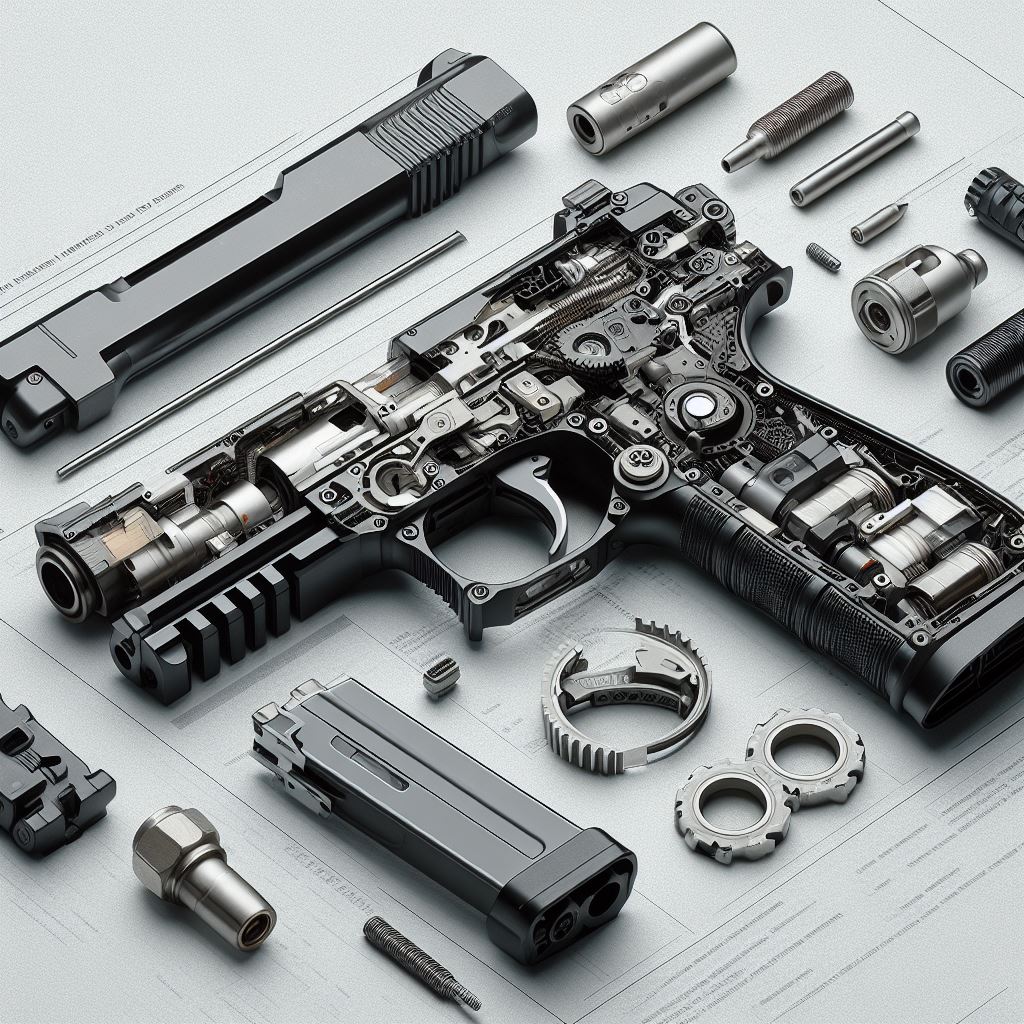
In February 2025, Maryland and Baltimore City launched a bold legal challenge against Glock, Inc., accusing the firearms giant of knowingly enhancing public danger by selling handguns that are easily converted into fully automatic weapons with inexpensive “auto sears.”[1] The lawsuit, deploying Maryland’s Gun Industry Accountability Act (GIAA), marks a sharp confrontation between state-level innovation and the sweeping immunity afforded to gun manufacturers under the federal Protection of Lawful Commerce in Arms Act (PLCAA).[2]
Enacted in 2005, PLCAA has long shielded firearms manufacturers from liability, broadly immunizing them from suits arising from criminal misuse of their products.[3] The Second Circuit underscored that claims of public nuisance, stemming from manufacturers’ distribution practices, fall within PLCAA’s robust barricade.[4] PLCAA allows a narrow “predicate exception”[5] for cases whose claims rest on violations of state or federal law “applicable to the sale or marketing” of firearms.[6] Maryland’s enactment of the GIAA appears to deliberately exploit that exception, forging a path around federal immunity by rendering Glock’s design choices and marketing subject to state-level liability.[7]
The complaint lays out a damning narrative: from 2023 to 2024, over 100 Glocks with full auto fire modifications were recovered by Baltimore police at crime scenes, nearly doubling from the prior year.[8] Moreover, approximately half of those arrested in connection with these modified weapons were under the age of 21, spotlighting the statute’s concerns for youth safety.[9] The firearms in question can be easily converted using attachments costing “as little as $20” or 3D-printed components, transforming a semi-automatic Glock into a weapon capable of firing “up to 1,200 rounds per minute.”[10] Plaintiffs contend that although Glock has long been aware of both the risks and potential design fixes, the company has failed to adequately respond. Glock has capitalized on the popularity of modified Glocks in video games and music marketed to a demographic particularly vulnerable to gun violence.[11] In pressing these claims, Maryland and Baltimore seek injunctive relief to halt sales of easily modified pistols, restitution, abatement, and other forms of accountability.[12]
Glock’s defense centers on PLCAA preemption, arguing that Maryland’s law contravenes federal intent by permitting liability for design and marketing decisions that fall squarely within gun manufacturer immunity.[13] Further, Glock maintains that the state statute is an unconstitutional attempt to circumvent PLCAA’s protections.[14] Additionally, Glock may file constitutional counter-claims, possibly invoking Second Amendment theories in the wake of Bruen,[15] with Glock contending that this regulatory approach effectively penalizes lawful design features and interferes with widespread lawful firearm ownership.[16]
Nevertheless, Maryland’s strategy follows in the footsteps of other state courts that have pierced PLCAA’s cloak.[17] In Connecticut, the highest court allowed victims of the Sandy Hook shooting to sue the manufacturer under a consumer protection statute targeting illegal marketing practices, creating a pathway that enabled a substantial settlement, which was later declined Supreme Court review.[18] That ruling underscores how targeted state regulations, carefully crafted to fall within the predicate exception, can survive PLCAA challenges.[19] By focusing on design modifiability that is demonstrably dangerous, and by invoking legislative findings on public safety harms, including the effect on youth and the overwhelming recovery of modified weapons, Maryland aims to place its challenge within the narrowly carved exception that PLCAA itself permits.[20]
Should the courts uphold Maryland’s claims, the result could ripple across the nation, legitimizing a cadre of state and municipal statutes trying to pierce federal gun manufacturer immunity.[21] Already, other jurisdictions have pursued similar avenues,[22] and a Maryland victory would validate those efforts and likely spur further legislation.[23] Conversely, if Glock prevails, it would reaffirm PLCAA’s sweeping protections, foreclose state efforts to hold manufacturers accountable, and possibly invite Supreme Court scrutiny if courts continue to split on interpretations of the predicate exception.[24]
Maryland’s invocation of its unique statute, tailored to address a specific, measurable public hazard, reflects a nuanced effort to test the boundaries of state police power in an area historically dominated by federal immunity.[25] At its core, this case underscores whether states can hold gun makers accountable in a meaningful manner for their design decisions that have had lethal consequences.[26] Ultimately, the case will indicate whether Maryland’s approach offers a workable model for regulating firearm design in furtherance of public safety or whether PLCAA’s protections remain impenetrable, marking the limits of state power against federal immunity.[27]

Jamison Young is a second-year day student at the University of Baltimore School of Law and a Staff Editor for the University of Baltimore Law Forum. He earned his bachelor’s degree in Environmental Science, with a minor in Spanish, from Roanoke College. At the University of Baltimore, Jamison serves as Secretary of the Environmental Law Society, a Law Scholar for Professor Koller in Civil Procedure II, and the UB LEADS Coordinator for the Student Bar Association. He was also inducted into the Royal Graham Shannonhouse III Honor Society. Jamison currently clerks for Coon & Cole, LLC in Towson, Maryland, and will serve as a Summer Associate at Hall Booth Smith, P.C., in Augusta, Georgia, this upcoming summer.
[1] Complaint and Demand for Jury Trial at 2, Mayor of Baltimore v. Glock, Inc., No. C-24-CV-25-001450 (Md. Cir. Ct. Feb. 12, 2025) (noting auto sears are commonly known as “Glock switches”).
[2] See supra note 1, at 7 (citing Md Code Ann., Cts. & Jud Proc. § 3-2503); Danielle J. Brown, State, Baltimore sue Glock for rise in modified guns that function like ‘illegal machine guns’, Maryland Matters (Feb. 12, 2025, at 9:37 PM), https://marylandmatters.org/2025/02/12/state-baltimore-sue-glock-for-rise-in-modified-guns-that-function-like-illegal-machine-guns/.
[3] Protection of Lawful Commerce in Arms Act, 15 U.S.C. §§ 7901–7903 (2018).
[4] City of N.Y. v. Beretta U.S.A. Corp., 524 F.3d 384, 389, 391 (2d Cir. 2008).
[5] Id. at 390.
[6] Protection of Lawful Commerce in Arms Act, 15 U.S.C. §§ 7903(5)(A)(iii) (2018).
[7] Md Code Ann., Cts. & Jud Proc. § 3-2503(a)(1).
[8] Complaint and Demand for Jury Trial, supra note 1, at 1–2.
[9] Id. at 31.
[10] Id. at 2, 12; see also Danielle J. Brown, State, Baltimore sue Glock for rise in modified guns that function like ‘illegal machine guns’, Md. Matters (Feb. 12, 2025, 21:37 ET), https://marylandmatters.org/2025/02/12/state-baltimore-sue-glock-for-rise-in-modified-guns-that-function-like-illegal-machine-guns/. (quoting that “[Attorney General] Brown said a Glock modified with an automatic sear can shoot up to 1,200 rounds per minute”).
[11] Complaint and Demand for Jury Trial, supra note 1, at 2–3, 32–33.
[12] Id. at 48, 50.
[13] Defendants’ Motion to Dismiss at 1–2, Mayor of Baltimore v. Glock, Inc., No. C-24-CV-25-001450 (Md. Cir. Ct. Jul. 23, 2025); Defendants’ Memorandum of Law in Support of Their Motion to Dismiss the Complaint at 3, 19–30, Mayor of Baltimore v. Glock, Inc., No. C-24-CV-25-001450 (Md. Cir. Ct. Jul. 23, 2025).
[14] Defendants’ Motion to Dismiss, supra note 13, at 1–2.; Defendants’ Memorandum of Law in Support of Their Motion to Dismiss the Complaint, supra note 13, at 3, 19–30.
[15] N.Y. State Rifle & Pistol Ass’n v. Bruen, 597 U.S. 1, 70 (2022) (quoting that “the Second Amendment guaranteed to ‘all Americans’ the right to bear commonly used arms in public subject to certain reasonable, well-defined restrictions” (citing District of Columbia v. Heller, 554 U. S. 570, 581 (2008)).
[16] Defendants’ Memorandum of Law in Support of Their Motion to Dismiss the Complaint, supra note 13, at 19.
[17] See, e.g., City of New York v. Beretta U.S.A. Corp., 524 F.3d 384 (2d Cir. 2008); Soto v. Bushmaster Firearms Int’l, LLC, 331 Conn. 53, 202 A.3d 262 (Conn. 2019).
[18] Soto, 331 Conn. at 133, 202 A.3d at 311 (Conn. 2019).
[19] Id.
[20] See Complaint and Demand for Jury Trial, supra note 1, at 2.
[21] Gun Industry Accountability, Giffords L. Ctr. to Prevent Gun Violence, https://giffords.org/lawcenter/gun-laws/policy-areas/other-laws-policies/gun-industry-immunity/#footnote_29_5605 (last visited Sep. 4, 2025) (depicting that currently, only nine states and D.C. have state gun industry accountability laws).
[22] See, e.g., Beretta, 524 F.3d 384; Soto,331 Conn. 53, 202 A.3d 262; Gustafson v. Springfield, Inc., 2025 Pa. LEXIS 442 (Pa. 2025); Nat’l Shooting Sports Found., Inc. v. James, 2025 U.S. App. LEXIS 17075 (2d Cir. 2025); Ileto v. Glock, Inc., 565 F.3d 1126 (9th Cir. 2009).
[23] See sources cited supra note 22.
[24] See Gun Industry Accountability, supra note 21 (highlighting in fractured decisions, the Second and Ninth Circuits determined that PLCAA barred suits brought under public nuisance statutes of general applicability).
[25] See Complaint and Demand for Jury Trial, supra note 1, at 2 (describing the auto sears are commonly known as “Glock switches”).
[26] Id.
[27] See id. (describing the auto sears are commonly known as “Glock switches”); Defendants’ Motion to Dismiss at 1–2, Mayor of Baltimore v. Glock, Inc., No. C-24-CV-25-001450 (Md. Cir. Ct. Jul. 23, 2025); Defendants’ Memorandum of Law in Support of Their Motion to Dismiss the Complaint at 3, 19–30, Mayor of Baltimore v. Glock, Inc., No. C-24-CV-25-001450 (Md. Cir. Ct. Jul. 23, 2025).






Leave a Reply