
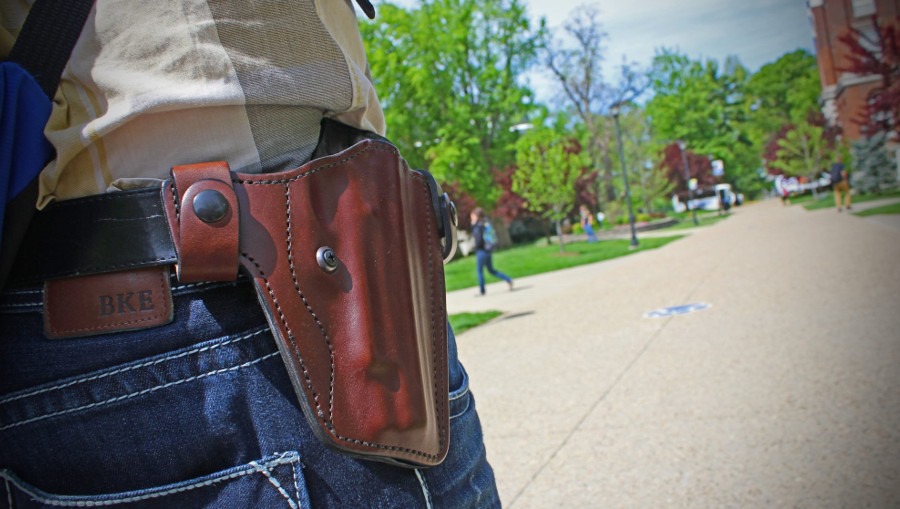
In New York State Rifle & Pistol Association, Inc.v. Bruen, the United States Supreme Court held that New York’s requirement that an applicant for a concealed carry permit prove “proper cause exists,” is unconstitutional under the Fourteenth Amendment.[1] Similar to Maryland, New York required applicants show a special need for self-protection distinguishable from that of the general community.[2] Though previously rejected, lower courts continued to employ a “means-end” approach, balancing the burden imposed on the right to bear arms against the governmental interest promoted by the regulation.[3] Rejecting a “means-end” approach once again, the Court scrutinized the licensing scheme through the text of the Second Amendment, as informed by history.[4] Finding no historical support for limiting public carry to those showing special need, the Court found that the Second Amendment made no distinction between carrying at home and in public, and guarantees the right to carry weapons in case of confrontation.[5] Thus, New York’s licensing scheme unconstitutionally prevented ordinary citizens from exercising their right to bear arms.[6]
For decades, Maryland was among the most restrictive states, requiring an applicant for a concealed carry license to prove, among other requirements, that a “good and substantial reason” existed to conceal carry a handgun.[7] Maryland courts defined a “good and substantial reason” as “something more than personal anxiety…” requiring the applicant to show they had actually been assaulted or received threats.[8] Commonly referred to as a “may issue” licensing scheme, the requirement allowed the Maryland State Police discretion to deny an application, regardless if the applicant met the statutory requirements.[9] In total, six states utilized a “may issue” licensing scheme including Maryland, New York, New Jersey, Massachusetts, California, and Hawaii.[10]
In response to Bruen, the Court of Special Appeals of Maryland found the similarities between New York’s “proper cause” and Maryland’s “good and substantial reason” requirements to be self-evident. Additionally, the court observed that Bruen expressly referred to Maryland as one of six states having an analogous standard.[11] Thus, Maryland’s “good and substantial reason” requirement was plainly unconstitutional.[12] By eliminating the discretionary standard, Maryland became a “shall issue” state, where an applicant who meets all statutory requirements must be granted a license.[13] The decision was a rare win for gun advocates in Maryland, as Maryland ranks seventh in gun law strength by Everytown for Gun Safety, a gun control advocacy organization.[14] Since the ruling, applications for concealed carry licenses soared over 700 percent compared to the same period one year ago.[15]
As gun advocates welcomed the decision, Maryland lawmakers warn new legislation limiting accessibility to firearms may be on the horizon.[16] Senate President for the Maryland General Assembly Bill Ferguson stated “… We will be reviewing the opinion and, if necessary, pass legislation that protects Marylanders and complies with this brand-new precedent.”[17] The rulings came after the Maryland General Assembly’s legislative session concluded, meaning new bills could not be voted on until 2023 when the General Assembly reconvenes.[18] With gun control more controversial than ever, it is obvious it will be a focus of the Maryland legislature. While it is unclear what the future of gun legislation in Maryland holds, it is clear that Maryland’s gun regulations have already drastically transformed.

Brandon Ewing is a third-year day student at the University of Baltimore School of Law and a Second-Year Staff Editor for Law Forum. Brandon graduated from Salisbury University in 2019, majoring in psychology and conflict analysis and dispute resolution. Currently, he is a student-attorney in the Bronfein Family Law Clinic. After graduation, he plans to focus on family law.
Read more: Signed, Concealed, Delivered: Maryland Concealed Carry Law Ruled Unconstitutional[1] N.Y State Rifle & Pistol Ass’n v. Bruen, 142 S. Ct. 2111, 2122 (2022).
[2] Id. at 2123.
[3] Id. at 2131; see District of Columbia v. Heller, 554 U.S. 570, 634 (2008).
[4] N.Y. State Rifle & Pistol Ass’n, 142 S. Ct. at 2127.
[5] Id. at 2134.
[6] Id. at 2156.
[7] Md. Code Ann., Pub. Safety § 5-306 (West 2022).
[8] See Scherr v. Handgun Permit Review Board, 163 Md. App. 417, 436-37, 880 A.3d 1137 (2005); see also Snowden v. Handgun Permit Review Board, 45 Md. App. 464, 466-67. 413 A.2d 295 (1980).
[9] Pub. Safety § 5-306
[10] N.Y State Rifle & Pistol Ass’n, 142 S. Ct. at 2122.
[11] In re Rounds, 279 A.3d at 1052.
[12] Id.
[13] Id.
[14] Everytown for Gun Safety, Gun Laws in Maryland, (Jan. 19, 2022), https://everytownresearch.org/rankings/state/maryland/?_gl=1%2Auyruw%2A_ga%2AMjA3MDM0NTA1My4xNjYyNzYyNTQx%2A_ga_LT0FWV3EK3%2AMTY2MjgxNzAxMy4zLjEuMTY2MjgxNzA0MC4wLjAuMA.
[15] Walter Morris, Concealed Carry Permit Applications Soar in Maryland, NBC D.C. (July 12, 2922, 8:07 AM), https://www.nbcwashington.com/news/local/concealed-carry-permit-applications-soar-in-maryland/3098367/.
[16] Josh Kurtz & Ariana Figueroa, U.S. Supreme Court Gun Rights Decision Has Major Implications for Md. Concealed Carry Law, Maryland Matters (June 23, 2022), https://www.marylandmatters.org/2022/06/23/u-s-supreme-court-gun-rights-decision-has-major-implications-for-md-concealed-carry-law/.
[17] Id.
[18] Id.


 ublawforum.com
Leave a comment