
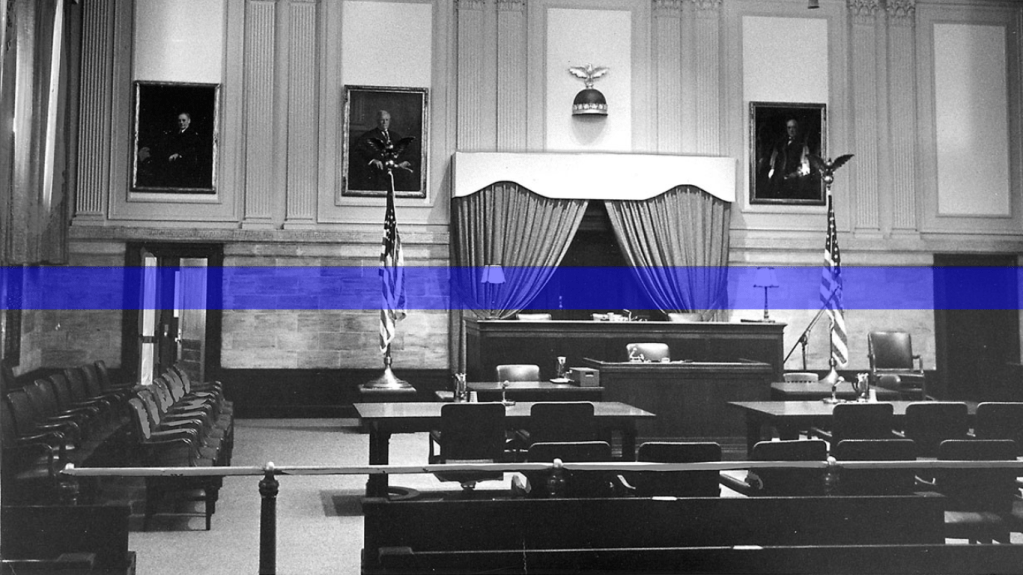
In a case of first impression, the Supreme Court of Maryland[1] held that the display of pro-law enforcement political messages by an officer of the court at a criminal trial threatens a defendant’s constitutional right to a fair trial. Smith v. State, 481 Md. 368, 414, 281 A.3d 931, 959 (2022). Specifically, the court said that displays such as the thin blue line flag create a risk that the jury will consider impermissible factors when rendering its decision and may be inherently prejudicial to the defendant. Id.
Amidst the height of the COVID-19 pandemic, another affliction was brewing. Following the murder of George Floyd, a Black man, by a White police officer, social groups assembled to protest against police brutality and law enforcement’s mistreatment of people of color. The Black Lives Matter movement received support from those who felt police needed to be held accountable, with some even calling to “defund the police.” At the same time, pro-law enforcement groups rallied together to show their support for the police. Many pro-law enforcement groups adopted the “thin blue line” flag as the expression of their movement. While the thin blue line is seen by some as a symbol of pride and support for law enforcement, others see it as a symbol that supports white supremacy and violence against people of color.
In October 2020, against this political climate, Everett Smith (“Smith”), a Black man, was on trial in the Circuit Court for Kent County for various criminal charges relating to the alleged assault of his teenage daughter. At the time, the County Sheriff required all bailiffs in his county to wear masks depicting the thin blue line, including the bailiffs present in the courtroom at Smith’s trial. Although Smith’s counsel opposed this practice, the court allowed the trial to proceed without requiring the bailiffs to change their masks. During the trial, the jury interacted with the bailiffs on numerous occasions. Ultimately, Smith was convicted of second-degree assault and second-degree child abuse by a custodian.
Following his conviction, Smith appealed to the Appellate Court of Maryland, arguing that the bailiffs’ thin blue line masks violated his constitutional right to a fair trial. The court rejected Smith’s contention and affirmed his conviction. Smith filed a petition for certiorari, challenging the intermediate court’s decision. The Supreme Court of Maryland granted cert.
The Supreme Court of Maryland began its analysis by establishing that the Sixth Amendment to the United States Constitution requires a fair trial and an impartial jury. Smith, 481 Md. at 392, 281 A.3d at 945-46. The court explained that a courtroom is “a neutral forum for the resolution of civil and criminal matters.” Id. at 400, A.3d at 950 (quoting State v. Jaime, 168 Wash. 2d 857, 233, 233 P.3d 554, 559 (2010)). Accordingly, a judge has a duty to guarantee that the jury will come to its decision based on the presented evidence alone. Smith, 481 Md. at 401, 281 A.3d at 951. In doing so, a judge must try to eliminate the appearance of bias towards a particular party. Id. The Sixth Amendment is violated when inherently prejudicial factors appear at a trial. Id. at 392-93, 281 A.3d at 946. Claims of inherent prejudice must be considered along with the particular facts and circumstances of each case. Id. at 400, 281 A.3d at 950. To demonstrate inherent prejudice, a defendant must have “objected to the challenged practice” during trial, establish based on the record that the jury observed the challenged practice during trial, and show that the challenged practice created the risk for impermissible factors to weigh on the jury’s deliberation and determination. Id.
Smith argued that his case was prejudiced by the bailiffs wearing thin blue line masks in the courtroom. Smith, 481 Md. at 390-91, 281 A.3d at 944-45. Smith reasoned that the symbol represents support for law enforcement and possibly urged jurors to “pick sides” between himself and the State. Id. at 391, 281 A.3d at 945. The State denied Smith’s position, stating that to show that the masks were inherently prejudicial, Smith must have established that they conveyed one “clear and unmistakable” message to the jury that spoke to his case in particular. Id. The court rejected the State’s position, stating that even if the symbol did not convey a specific message to the jury, the masks were still problematic. Id. at 403-04, 281 A.3d at 952. Because the State may utilize law enforcement assets against a criminal defendant, any pro-law enforcement message is improper at a criminal trial. Id. at 402, 281 A.3d at 951. Therefore, even “the most benign” message related to the masks did not belong at Smith’s trial. Id. at 403-04, 281 A.3d at 952.
The court next addressed Smith’s position that because a bailiff is an officer of the court, the jury would believe the court approved any message they conveyed. Smith, 481 Md. at 405, 281 A.3d at 953. The court agreed, reasoning that, unlike members of the gallery, as an officer of the court, any message conveyed by a bailiff to the jury could be attributed to the court. Id. at 405-06, 281 A.3d at 953-54. Because of this, the donning of the thin blue line symbol by the bailiffs at Smith’s trial had the potential for prejudice. Id. at 406, 281 A.3d at 954. The court also rejected the State’s attempt to equate the bailiffs’ masks with general law enforcement uniforms, reasoning that unlike the masks, a uniform is normal attire in the context of a courtroom, not a “controversial political symbol” that sparks the potential for bias towards law enforcement. Id. at 407, 281 A.3d at 954-55.
The court went on to explain that given the polarized state of the nation following George Floyd’s murder, the possibility of impermissible factors coming into Smith’s trial was exacerbated. Smith, 481 Md. at 408, 281 A.3d at 955. At a time when social groups were calling to “defund the police,” the bailiff’s display of the controversial symbol in the courtroom could have reasonably caused the jury to believe that the court was siding with the State and implicitly telling them to do so as well. Id. at 411-12, 281 A.3d at 957. Such potential for bias was increased given the political climate in the United States at the time of Smith’s trial. Id. at 408, 281 A.3d at 955.
Finally, the State argued that Smith failed to sufficiently document the claimed prejudice. Smith, 481 Md. at 392, 281 A.3d at 945. The court disagreed, reasoning that because the jury had significant interaction with the bailiffs throughout the trial, because bailiffs are authority figures in a courtroom, and because masks were generally referenced throughout the trial, the jury had ample opportunity to observe the masks and possibly be influenced by their presence and messaging. Id. at 412-14, 281 A.3d at 958-59. Therefore, the court stated that the thin blue line masks inherently prejudiced Smith’s right to a fair trial. Id. at 414, 281 A.3d at 959. As such, Smith’s case was reversed and remanded for a new trial. Id.
In his dissenting opinion, Justice Gould, joined by Justice Getty, voiced his position that the thin blue line masks did not infringe on Smith’s right to a fair trial. Smith, 481 Md. at 422, 281 A.3d at 963-64 (Gould, J., dissenting). Justice Gould criticized the majority for failing to describe how the masks’ message, as perceived in Kent County specifically, risked introducing impermissible factors at Smith’s trial. Id. at 414, 417, 281 A.3d at 959, 961 (Gould, J., dissenting). He also questioned the chances that any message conveyed by the masks would be considered by a jury during a trial for a father’s assault of his daughter, which does not concern police misconduct. Id. at 420, 281 A.3d at 962 (Gould, J., dissenting).
In Smith, the Supreme Court of Maryland held that officers of the court displaying political messages at a criminal trial risk introducing impermissible factors that may impact the jury’s decision and inherently prejudice the defendant’s constitutional right to a fair trial. It is not hard to imagine a similar scenario occurring again considering the growing political divide in America. With social movements and symbols originating daily, Maryland courts will need to constantly evaluate the attire of court officials and possibly spectators in future cases. While this promotes a politically neutral atmosphere, it also usurps a certain level of freedom of expression. With the boundaries of what Maryland courts consider politically permissible attire unclear, Maryland practitioners must continue fighting for their clients’ rights to a fair trial while remaining mindful of the constitutional rights of others present in the courtroom.

Yakira Price is a 3L at the University of Baltimore School of Law and an Articles Editor for Law Forum. She earned a Bachelor of Psychology from Gratz College, magna cum laude. After her 1L year, Yakira was inducted as a Distinguished Member into the Royal Graham Shannonhouse III Honor Society. During her 1L summer, Yakira worked as a Law Clerk at Hyatt & Weber, P.A., and as a Legal Intern for the Honorable Daniel A. Friedman on the Appellate Court of Maryland. Since the beginning of her 2L year, Yakira has been working as a Law Clerk at Niles, Barton & Wilmer, LLP in the firm’s insurance defense litigation practice group.
[1] At the November 8, 2022, general election, the voters of Maryland ratified a constitutional amendment changing the name of the Court of Appeals of Maryland to the Supreme Court of Maryland and the Court of Special Appeals of Maryland to the Appellate Court of Maryland. The name change took effect on December 14, 2022.



 ublawforum.com
Leave a comment