
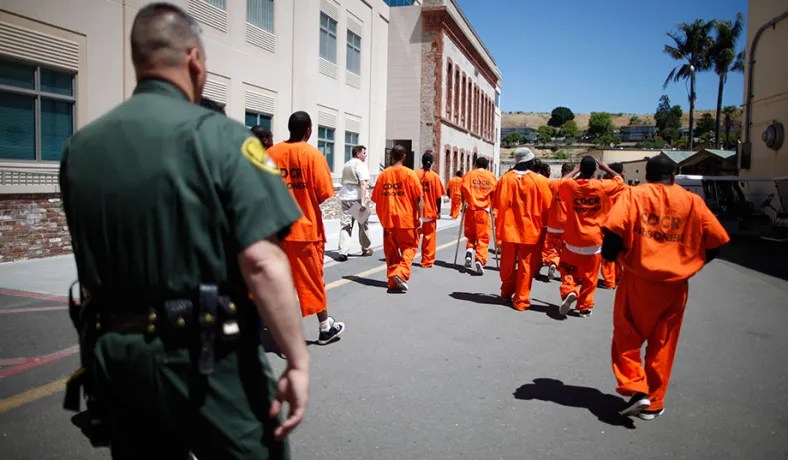
The Fair Labor Standards Act (“FLSA”) was created in 1938[1] to protect vulnerable workers who lack bargaining power and to prevent unfair competition.[2] The FLSA guarantees basic protections for employees like minimum wage, overtime pay,[3] and privacy for pumping breastmilk.[4] Some groups are exempt from the FLSA in its plain text; however, incarcerated persons are not.[5] Nevertheless, the Fourth Circuit has excluded work done within the walls of a prison from the FLSA’s reach because it is “not [done] in the competitive market,”[6] notwithstanding the fact that most prisons are run by private corporations that contract with the federal or state government.[7] The Fourth Circuit’s case law excludes incarcerated workers from the definition of “employee” if their work is performed for rehabilitative purposes rather than primarily for the profit of the employer. [8] The subject of work done by incarcerated persons outside of the prison is a new issue for the Fourth Circuit. Scott v. Baltimore County is now before the Fourth Circuit on appeal from the United States District Court for the District of Maryland.[9]
In Scott, persons incarcerated in the Baltimore County prison brought a lawsuit against the county for violating the FLSA by paying them below minimum wage.[10] The incarcerated persons participated in a supervised work program in which they sorted materials at the county’s Material Recovery Facility.[11] They worked for about $20 per day and had to provide their own clothing in the open-air facility in winter and sometimes their own food.[12] The District Court found that this work was primarily rehabilitative, while acknowledging that the county has an economic interest in using cheap prison labor.[13] The District Court reasoned that a market advantage for the government, as the county had here, amounted to payment for public goods, but a market advantage for a private employer would likely fall under the FLSA’s purview.[14]
The ACLU submitted an amicus brief outlining how prison labor arose as, and continues in the tradition of, a replacement for slavery.[15] Their brief also notes how Baltimore County’s, and all of Maryland’s, prison population is disproportionately Black, so this issue disproportionately affects Black inmates.[16] The Fourth Circuit has an opportunity to provide incarcerated persons the protection they are due as vulnerable workers under the FLSA. Dehumanizing a person by working the same job as the person next to him or her, but in worse conditions and receiving a mere fraction of the other person’s pay, violates equal protection under the 14th Amendment as well as the purpose of the FLSA.[17] Incarcerated persons must receive fair pay for their contributions to a county benefiting from employing them. Incarcerated persons have expenses they must cover, too, as well as a future to save for. Having some savings upon release due to working for minimum wage may also help reduce recidivism because the individuals would have some financial support to fall back on, rather than falling back into crime.

Sara von Stein is a fourth-year evening student at the University of Baltimore School of Law and an Associate Editor for Law Forum. Sara received her Master’s in Gender and Sexuality Studies from Birkbeck College in 2015. She works as a Trust and Estates paralegal at Elville and Associates, P.C., where she assists with estate planning, estate and trust administration, and related litigation. Sara previously worked at a humanitarian immigration law firm, Law Office of Jennifer Alonso, for three years.
[1] Jonathan Grossman, Fair Labor Standards Act of 1938, U.S. Dep’t of Labor, https://www.dol.gov/general/aboutdol/history/flsa1938 (last visited Oct. 21, 2023).
[2] 73 Fed. Reg. 67987 (Nov. 17, 2008).
[3] Wages and the Fair Labor Standards Act, U.S. Dep’t of Labor, https://www.dol.gov/agencies/whd/flsa#:~:text=The%20Fair%20Labor%20Standards%20Act%20(FLSA)%20establishes%20minimum%20wage%2C,%2C%20State%2C%20and%20local%20governments (last visited Oct. 21, 2023).
[4] FLSA Protections to Pump at Work, U.S. Dep’t of Labor, https://www.dol.gov/agencies/whd/pump-at-work (last visited Oct. 21, 2023).
[5] Brief for American Civil Liberties Union et al. as Amici Curiae Supporting Appellants at 2-3, Scott v. Balt. Cnty., No. SAG-21-00034, 2023 U.S. Dist. LEXIS 101096 (D. Md. June 9, 2023).
[6] Harker v. State Use Indus., 990 F.2d 131, 136 (4th Cir. 1993).
[7] Correctional Facilities in the US – Market Size, Industry Analysis, Trends and Forecasts (2023-2028), IBIS World (Mar. 2023) https://www.ibisworld.com/united-states/market-research-reports/correctional-facilities-industry/#IndustryStatisticsAndTrends. President Biden issued an executive order to end prison contract with private companies, so this is set to change. BOP Ends Use of Privately Owned Prisons, Fed. Bureau of Prisons, (Dec. 1, 2022) https://www.bop.gov/resources/news/20221201_ends_use_of_privately_owned_prisons.jsp.
[8] Harker, 990 F.2dat 134.
[9] Madeleine O’Neil, Baltimore County inmates’ minimum wage lawsuit appealed to the Fourth Circuit, Daily Record (Oct. 13, 2023) https://thedailyrecord.com/2023/10/13/baltimore-county-inmates-minimum-wage-lawsuit-appealed-to-4th-circuit/.
[10] Scott v. Balt. Cnty., No. SAG-21-00034, 2023 U.S. Dist. LEXIS 101096, at *2 (D. Md. June 9, 2023).
[11] Id.
[12] Id. at *4-*5.
[13] Id. at *42.
[14] Id. at *52.
[15] Brief at *2, Scott v. Balt. Cnty., No. SAG-21-00034, 2023 U.S. Dist. LEXIS 101096 (D. Md. June 9, 2023).
[16] Id. at *10.
[17] See Grossman, supra note 1; U.S. Const. amend. XIV.



 ublawforum.com
Leave a comment