
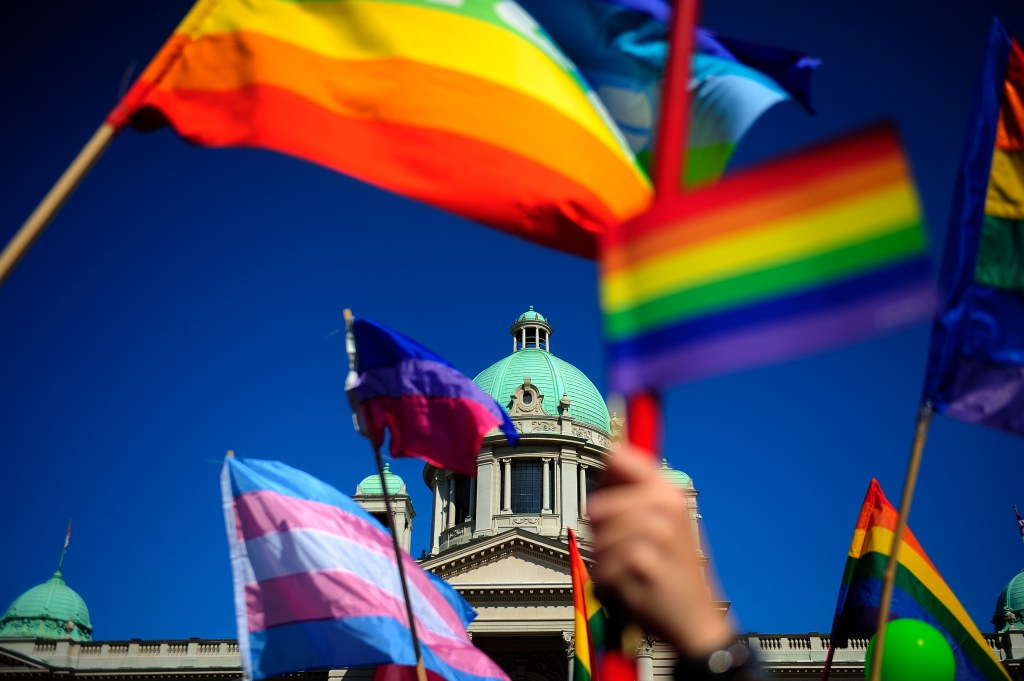
In 2023, 600 “anti-trans”[1] bills were filed within the United States.[2] Anti-trans bills primarily attack “gender-affirming care, education, athletics, birth certificates, legal recognition, religious discrimination,” and public restroom use for transgender persons.[3] Despite only 1.6% of the population in the United States identifying as transgender or nonbinary,[4] this minute group of individuals has been politically weaponized across the country.[5] Whether it is preventing transgender individuals from using public restrooms to keep women safe or stopping children from being educated about sex to maintain their purity, legislators have demonized the transgender population in an effort to cause outrage and gain votes.[6] This tactic has had numerous adverse impacts on the transgender community and its members, including exposing them to unwarranted violence and limiting their ability to access essential medical care.[7]
This damning legislative trend has continued into 2024.[8] In Maryland this year, three anti-trans bills were introduced in the General Assembly.[9] While those bills have seen little movement within the state legislature, a “pro-trans” bill—cross-filed as SB119 and HB691—has passed both of the General Assembly’s bodies and been signed by the Governor.[10] The Bill, which Governor Wes Moore signed into law on May 16, 2024, will statutorily shield transgender healthcare providers from civil and criminal liability and protect transgender patients from public and private investigators.[11] The Bill will accomplish this by expanding legally protected healthcare in the state to include gender-affirming care.[12] The Governor likely signed the Bill into law to enshrine his June 2023 executive order, which protected gender-affirming care recipients and providers from out-of-state legal action, into Maryland law.[13]
The Bill expands the definition of “legally protected healthcare” under section 2-312 of the Maryland code’s State Personnel and Pensions article[14] to include “gender–affirming treatment” as defined by section 15-151 of the Health-General article.[15] The Bill uses the recently established legally protected healthcare mechanism[16] to protect providers from liability when they administer gender-affirming care.[17] This mechanism also protects transgender patient’s medical information from investigators.[18] Currently, the only other category of healthcare listed as legally protected healthcare is women’s reproductive health.[19]
This Bill becoming law demonstrates Maryland’s commitment to protecting an individual’s right to receive medical care from rhetorical political antics.[20] While some legislators have taken issue with the legal measures Maryland has recently taken in this field, these laws are needed.[21] Maryland should continue to protect an individual’s right to receive medical care so long as politicians push harmful myths and stereotypes about healthcare and healthcare providers for publicity, particularly when it comes to transgender persons and gender-affirming care.[22] Gender-affirming care has historically been shown to improve the physical and mental health of transgender individuals,[23] and the treatments often prevent transgender persons from committing suicide.[24]
This Bill validates individual rights and shields gender-affirming healthcare recipients and practitioners from unwarranted attacks as misinformation is wrongfully spread about them for publicity.[25] Additionally, the Bill will ensure that the small transgender population within Maryland[26] is not subjected to scrutiny that would wrongly jeopardize their wellbeing for the sake of short-term political gain.[27]

Emmett Hallameyer is a third-year day student at the University of Baltimore School of Law and an Articles Editor for Law Forum. Emmett graduated from Stevenson University Magna Cum Laude in 2021 with a B.S. in legal studies. Emmett is also a member of the law school’s National Trial Competition Team and a law scholar for criminal law. Emmett interned for the Maryland Attorney General’s Organized Crime Unit before law school, and upon graduation, Emmett hopes to pursue a career in criminal law or civil rights law.
[1] Jackie Turner, The Anti-Trans Movement Framework, The Commons (2023), https://commonslibrary.org/the-anti-trans-movement/ (“[T]o achieve a shared agenda of: Eliminating the rights, protections, and legal recognition of trans and gender diverse people; Banning gender-affirming health care; Institutionalization of anti-trans conversion practices as the primary model of care for trans and gender diverse people; Barring trans people’s participation in public life; Increasing the level of public hostility (violence, abuse, harassment) towards trans people.”).
[2] 2023 Anti-Trans Legislation, Trans Legis. Tracker, https://translegislation.com/bills/2023 (last visited Apr. 18, 2024).
[4] Anna Brown, About 5% of Young Adults in the U.S. Say Their Gender is Different From their Sex Assigned at Birth, Pew Rsch. Ctr. (June 7, 2022), https://www.pewresearch.org/short-reads/2022/06/07/about-5-of-young adults-in-the-u-s-say-their-gender-is-different-from-their-sex-assigned-at-birth/.
[5] See Nicole Scott, Trans Rights Are Human Rights: Protecting Trans Minors’ Right to Gender-Affirming Care, 14 Drexel L. Rev. 685, 707 (2022).
[7] Groundbreaking Survey Sheds New Light on Trans Life in Maryland, Univ. of Md., Coll. of Educ. (Apr. 1, 2024), https://education.umd.edu/news/04-01-24-groundbreaking-survey-sheds-new-light-trans-life-maryland (“The survey . . . found that . . . 78.2% report[ed] at least one instance of verbal abuse and 46.1% report[ed] physical abuse . . . . 85.2% experienced barriers to access.”).
[8] 2024 Anti-Trans Bills Tracker, Trans Legis. Tracker, https://translegislation.com/ (last visited Apr. 18, 2024).
[9] Maryland, Trans Legis. Tracker, https://translegislation.com/bills/2024/MD (last visited Apr. 18, 2024) (Describing the cross-filed House Bill 47 and Senate Bill 381—the “Fairness In Girls’ Sports Act”—and House Bill 722—Prohibiting healthcare providers from providing gender-affirming procedures on a minor without a parent’s consent).
[10] Maryland Poised to Become Trans Sanctuary State, Blade (Apr. 6, 2024), https://www.losangelesblade.com/2024/04/06/maryland-poised-to-become-trans-sanctuary-state/; [Hereinafter the Bill].
[11] Brian Witte, Maryland Senate Approves Legal Protections for Gender-Affirming Care, The Assoc. Press (March 5, 2024), https://apnews.com/article/gender-affirming-treatment-maryland-85007cc3244f89953d316a609f81dbf1.
[13] See COMAR, 01.01.2023.08.
[14] Md. Code Ann., State Pers. & Pens. § 2-312 (West 2023).
[15] See Md. Code Ann., Health-Gen. § 15-151 (West 2023).
[16] See H.D. 808, 2024 Gen. Assemb., 445th Sess. (Md. 2023) (enacted).
[17] S. 119, 2024 Gen. Assemb., 446th Sess. (Md. 2024).
[18] Id.
[19] Md. Code Ann., State Pers. & Pens. § 2-312 (West 2023).
[20] See Hannah Gaskill, Trans Health Equity Act to Provide Care for Low-income Marylanders in 2024, Balt. Sun (Dec. 30, 2023), https://www.baltimoresun.com/2023/12/30/trans-health-equity-act-to-provide-care-for-low-income-marylanders-in-2024/ (explaining how Maryland’s Medicaid system will be expanded to cover gender-affirming care); see also Helen Santoro, Gender-Affirming Care for Trans Youth: Separating Medical Facts from Misinformation, CBS News (June 28, 2023), https://www.cbsnews.com/news/trans-youth-gender-affirming-health-care-misinformation/.
[21] See Witte, supra note 11 (“Republicans who opposed the bill argued the measure would expand access to gender-affirming care to youths who could decide to have treatments that could have a permanent effect on them when they are at a vulnerable period in their lives.”).
[22] See Laura Santhanam, Majority of Americans Reject Anti-Trans Bills, but Support for this Restriction is Rising, Pub. Board. Station (Mar. 29, 2023), https://www.pbs.org/newshour/politics/majority-of-americans-reject-anti-trans-bills-but-support-for-this-restriction-is-rising (reporting that in March 2023, 43% of people supported criminalizing gender-affirming care for minors, a 15% increase from April 2021, when only 28% of people did); see also Santoro, supra note 20.
[23] See Heather Boerner, What the Science on Gender-Affirming Care for Transgender Kids Really Shows, Scientific Am. (May 12, 2022), https://www.scientificamerican.com/article/what-the-science-on-gender-affirming-care-for-transgender-kids-really-shows/.
[24] See David Inwards-Breland, Mental Health Outcomes and Receipt of Gender-Affirming Care, Am. Acad. of Pediatrics (Oct. 11, 2021), https://www.aap.org/en/news-room/news-releases-from-aap-conferences/research-finds-significant-reduction-in-depression-suicidality-in-youth-receiving-gender-affirming-care-or-puberty-blockers/; see also Santoro, supra note 20 (“[T]hose who had started on puberty blockers or hormone therapy had 60% lower odds of depression and 73% lower odds of self-harm or suicidal thoughts . . . .”).
[25] See Santoro, supra note 20 (“Such laws and policies . . . reflect misconceptions and misinformation that conflate treatments and strip trans youth of essential care.”).
[26] Tommy Tucker, Trans Patients Face Geographic Availability Barriers to Care, Medications, Md. Matters (Jan. 2, 2024), https://www.marylandmatters.org/2024/01/02/trans-patients-face-geographic-availability-barriers-to-care-medications/ (“24,000 transgender adults live in Maryland . . . .”).
[27] See Scott, supra note 5.



 ublawforum.com
Leave a comment