
By: Cameron Luzarraga*
- Introduction
Managing municipal waste while ensuring safe air quality is a difficult task.[1] Landfills are expensive, require vast areas of land, and emit carbon dioxide (“CO2”) and other harmful pollutants into the air.[2] Waste-to-energy (“WTE”) incineration—the process of turning garbage into electricity—is often marketed as the low-carbon alternative.[3] However, for decades, South Baltimore residents living near the Wheelabrator[4] waste-to-energy incinerator have expressed adverse health concerns.[5] Waste incineration exposes people living near the facilities to a wide range of toxins.[6] Health concerns are even greater when in highly populated urban areas.[7] Moreover, burning trash is a step backward in the battle against climate change.[8] This comment argues that Maryland must adopt recycling and source-reduction laws as stringent as those in Germany to divert waste from waste-to-energy incinerators and to ensure clean air for its citizens. Additionally, Maryland should invest in carbon capture usage and storage (“CCUS”) technology to offset the carbon emissions associated with waste management.
The following sections of this comment will examine existing recycling laws and propose improvements for Maryland’s regulations. Section II discusses the evolution of waste-to-energy incineration and the regulatory framework governing these facilities.[9] This section will analyze Maryland’s relationship with the Clean Air Act of 1970.[10] Section II also will address the regulations guiding recycling in Maryland.[11] Lastly, this section will outline waste policies in the European Union and with an emphasis on Germany.[12]
Section III will explain how waste incineration harms human health and the environment.[13] Moreover, this section will explore why current air regulations are inadequate and why recycling has been underutilized.[14] Finally, this section will argue that a fault in current environmental legislation is the failure to address CO2 capture in waste incineration.[15]
Section IV will propose three solutions that focus on reducing the amount of waste that flows into incineration facilities.[16] Maryland can model its extended producer responsibility program after that of Germany by adopting a plastic packaging law[17] and by instituting a plastic bottle deposit return scheme.[18] These two strategies will impose obligations on producers and consumers to decrease the amount of municipal waste generated.[19] Finally, Maryland should invest in CCUS as the future of waste management.[20] The consequences of inaction are too significant to neglect research and development in this area,[21] and a solution supporting cleaner air mitigates climate change.[22]
- Background
- Waste-to-Energy Regulation and the Clean Air Act
- Wheelabrator Baltimore and the Baltimore Clean Air Act
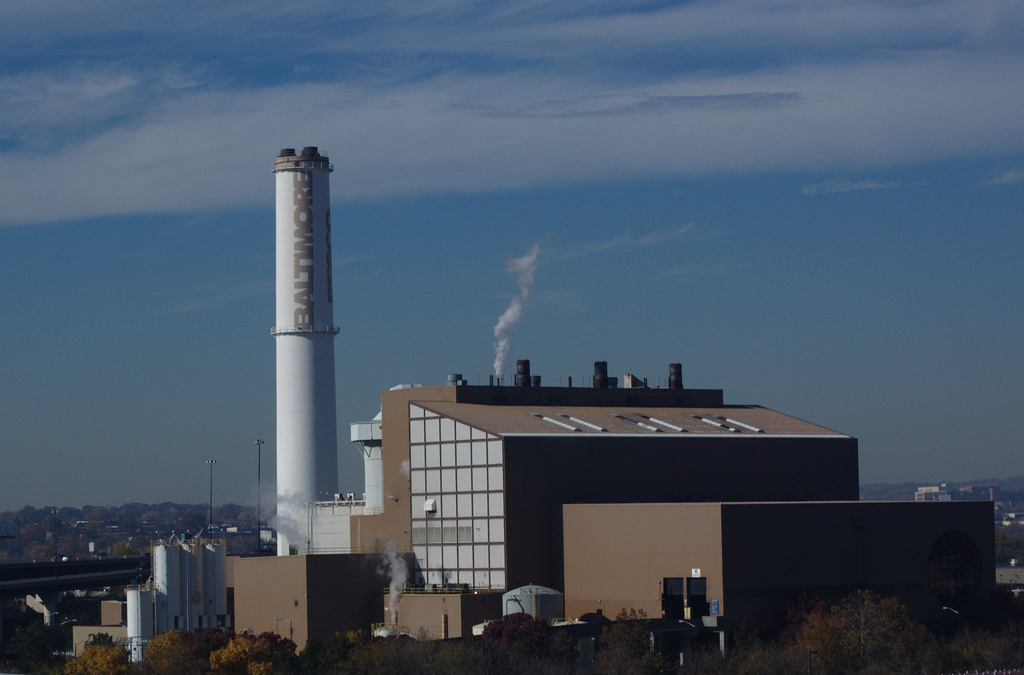
The Baltimore Refuse Energy Systems Company (“BRESCO”) incinerator (“Wheelabrator”) is a waste-to-energy (“WTE”) incinerator located in the Westport neighborhood of Baltimore, Maryland.[23] First opened in 1985, this towering white smokestack may be seen by travelers entering Baltimore along Interstate-95 or the Baltimore-Washington Parkway.[24] The Wheelabrator burns Baltimore’s solid municipal waste, creating steam that powers an electric generator turbine.[25] The Wheelabrator is a stationary source, meaning that the federal Clean Air Act, in tandem with state regulation and enforcement, applies to the Wheelabrator.[26] Local government has tried to assert jurisdiction over the operation of the Wheelabrator without success.[27]
The United States District Court for the District of Maryland held that the Baltimore Clean Air Act (“BCAA”)[28] was conflict preempted by Maryland’s Title V permitting system.[29] In 2019, Baltimore City passed the BCAA to limit emissions of various pollutants,[30] require continuous emissions monitoring systems,[31] and penalize violations.[32] In 2019, Wheelabrator sued Baltimore City and the mayor, alleging that federal and state laws preempted the BCAA.[33] The district court agreed with Wheelabrator and found that the BCAA prohibited, sanctioned, and criminalized actions allowed under Maryland’s Title V permitting system.[34] The BCAA also set stricter caps on emissions and increased the number of pollutants monitored by facilities.[35] Therefore, the BCAA was conflict preempted by state law because, as a local law, the BCAA challenged the Maryland Department of the Environment (“MDE”)’s supremacy over state compliance with national standards.[36]
- The Clean Air Act and Cooperative Federalism
The Clean Air Act Amendments of 1970[37] (“CAA”) were passed in response to two public sentiments: disapproval of environmental degradation and optimism for a new technological era.[38] In contrast to previous environmental laws, the CAA comprises uniform, national standards set by Congress to address a wide range of pollutants and sources.[39] Under the CAA, states work with the federal government through co-existing and separate regulations.[40]
The CAA, in many ways, exemplifies a “cooperative federalism” structure that strikes a balance between federal standard setting and state implementation in the United States (“US”).[41] The CAA authorizes the Environmental Protection Agency (“EPA”) to establish the National Ambient Air Quality Standards (“NAAQS”) that represent the maximum concentration of a particular “pollutant that the public health can tolerate.”[42] Today, the NAAQS are in effect for six pollutants: carbon monoxide, lead, ground-level ozone, nitrogen dioxide, particulate matter, and sulfur dioxide.[43] After the EPA prescribes maximum thresholds through the NAAQS, states must create their State Implementation Plans (“SIP” or “SIPs”) to demonstrate how they will meet the NAAQS deadlines.[44] Thus, the EPA and states are jointly responsible for implementing air quality standards.[45]
WTE incinerators are subject to the CAA because of concerns about their air pollution.[46] Under the CAA, the EPA initially sets federal source performance standards for WTE incineration facilities, which the states must then implement.[47] First, the CAA requires the EPA to establish New Source Performance Standards (“NSPS”)[48] and emissions guidelines for new and existing solid waste incineration facilities.[49] Second, the EPA enacts Maximum Achievable Control Technology (“MACT”) standards to reduce hazardous air pollutant emissions.[50] Under these MACT standards, existing facilities must retrofit their air pollution control systems or else risk closure by the EPA.[51] Regulations specifically targeted at WTEs are necessary because the facilities release pollutants covered within and outside of the NAAQS’s control.[52]
Finally, states must ensure that major pollution sources obtain and comply with federal permits.[53] Title V of the CAA requires WTE facilities to obtain an operating permit and routinely submit compliance forms to the EPA.[54] While facilities must comply with the EPA, under cooperative federalism, the states still have significant power by granting or denying those permit applications.[55] In Maryland, the MDE ensures state compliance with the CAA.[56]
- European Policies for Waste-To-Energy and Clean Air
The CAA’s cooperative federalism scheme shares similarities with the European Union (“EU”)’s relationship to its member states. Stringent regulations on air pollutants have been implemented due to public concerns over air quality and the common use of WTE facilities.[57] For example, the European Union Waste Incineration Directive (the “WI Directive”) and the German Emission Control Act illustrate regulations governing waste incineration.[58]
- The European Waste Incineration Directive
The WI Directive[59] establishes conditions and minimum technical requirements[60] for waste incinerators operating within EU member states.[61] The WI Directive sets thresholds for air pollutants like “dust, nitrogen oxides, sulfur dioxide, hydrogen chloride, hydrogen fluoride, heavy metals, and dioxins and furans.”[62] The WI Directive is legally binding and must be implemented into each member state’s national law.[63] While member states must comply with these minimum requirements, they can freely establish more stringent measures.[64] Like the CAA, the WI Directive aims to reduce air pollution by setting emission limits on facilities and allowing local authorities to use operating permits as regulatory instruments.[65]
The WI Directive shares enforcement similarities with the CAA and the EPA but is generally stricter. Both the EU and the US have waste management hierarchies and prefer waste incineration over alternatives like landfills.[66] However, European WTE developers also must consider the environmental impact of building a new facility by drafting Environmental Impact Statements.[67] Moreover, the WI Directive has been amended several times to capture the needs of the EU and evolving scientific information.[68] Therefore, the WI Directive is a successful model for waste incineration policies.
- Germany & Waste Incineration
The Directive was based on the German Emission Control Act (“Control Act”).[69] Germany was an early adopter of waste incineration, with its first facility opening at the close of the nineteenth century.[70] Like most industrialized nations, Germany considers waste incineration as environmentally preferable to landfilling.[71] To minimize the negative environmental and human health effects of incineration, Germany has established strict national standards outlined in the Control Act.[72]
The Control Act[73] governs waste incineration in Germany.[74] When signed into national law, this ordinance set the strictest emission limits globally.[75] Like the NAAQS, the Control Act focuses on ambient air quality and aims to limit pollutants harmful to public health.[76] The Control Act sets time periods for existing WTE incinerators to be retrofitted with the newest containment technologies before they are shut down for noncompliance.[77]
Waste Incineration is developed and highly regulated in Germany, but its future is uncertain.[78] Historically, Germany has relied on WTE facilities to handle municipal waste and reduce landfill usage.[79] Unlike the US, waste combustion accounts for a significant portion of German waste management.[80] Public pressure surrounding German dependence on these facilities led its government to implement stringent emissions regulations.[81] Upgrades to air pollutant capture in the facilities have coincided with efforts to promote reuse and recycling.[82] Germany now recognizes waste prevention and recycling strategies as the ideal approach to waste management.[83]
- Maryland Recycling Act
The Maryland Recycling Act (the “MRA”), which outlines the state’s waste management plan, encourages waste reduction by setting minimum recycling targets and by crediting counties that make significant reductions.[84] Maryland counties with populations over 150,000 must recycle at least 35% of their solid waste per year.[85] To encourage compliance, state and local authorities can deny construction permits to jurisdictions that fail to meet these reductions.[86] In 2021, the Maryland recycling rate was 42.5% of municipal waste generated.[87] This is higher than the US’s national average (32%),[88] but significantly lower than that of Germany (67%).[89]
The MRA encourages additional recycling commitments through the Maryland Source Reduction Credit System.[90] Source reduction activities include promotion of recycling, composting, textile reuse, and the development of food composting educational sites.[91] To incentivize these activities, the state provides a 5% source reduction credit.[92] The source reduction credit is divided into a 2% credit for specific reduction programs—like a program that promotes the reduction of textile waste—and a 3% credit for more general waste reduction programs.[93] In 2021, Baltimore City did not receive any source reduction credit.
Recycling programs in Maryland, like the rest of the US, are largely overseen at the state and local levels.[94] At the federal level, the EPA advocates for a “circular economy” where industrial processes and consumption should keep “materials, products, and services in circulation for as long as possible.”[95] Thus, the MRA’s recycling targets and source reduction credits encourage the state’s circular economy.
- European Waste Management Plans and Policies
- The European Union and Waste Hierarchy
The EU established the Waste Framework Directive[96] (“WF Directive”) to address the environmental and human health concerns associated with waste management.[97] The WF Directive establishes the governing principles of European waste management, including the waste hierarchy and the importance of a circular economy.[98] EU member states must take measures to comply with the waste reduction objectives of the WF Directive.[99]
The foundation of European waste management is the waste hierarchy.[100] The waste hierarchy is a five-tiered chart outlining the preferences for waste management and disposal.[101] From most to least preferable, the order is (1) prevention, (2) preparing for non-use, (3) recycling, (4) recovery, and (5) disposal.[102] Preventing waste is the preferred option, and sending waste to the landfill should be the last resort.[103] The EU waste hierarchy is like the EPA’s non-hazardous waste management hierarchy, which ranks waste management strategies from most to least environmentally preferred.[104] The notable distinction is that compliance with the EU’s waste hierarchy is mandatory.[105]
The EU ensures compliance with the WF Directive by requiring self-reporting by national governments and by publishing reports.[106] Member states must annually report to the European Commission regarding the status of their implementation of the WF Directive, including achievements of waste reduction targets.[107] The European Commission then publishes annual reports identifying which nations are on track to meet the recycling and landfilling targets.[108] The EU also provides financial, technical assistance, and guidance to member states at risk of missing one or more targets.[109] Collectively, the EU’s promotion of the waste hierarchy and the circular economy has led to waste prevention across Europe.[110]
- Germany is a world-leader in waste reduction and recycling.
Germany is the global leader in recycling and waste management.[111] The country’s success can be attributed to its legal framework, such as the Circular Economy Act and the Packaging Act.[112] In addition, Germany’s success can be attributed to the federal states’[113] waste management plans.[114]
The Circular Economy Act (the “KrWG”)[115] serves as the principle legal framework for German waste management. The KrWG is health- and environment-focused and seeks to reduce waste generation and improve disposal practices.[116] The KrWG also transformed the EU’s WF Directive into national law.[117] Moreover, the KrWG has set recycling targets for Germany that are more ambitious than the WF Directive requirements.[118]
The German Packaging Act (“VerpackG”) creates waste-stream specific regulations to reduce the harms of packaging waste. The VerpackG continues to evolve and include amendments with even more ambitious targets.[119] The binding requirements set out in the VerpackG apply to all packaging manufacturers and distributors within Germany.[120] There are mandatory recycling fees imposed on companies to improve recycling rates.[121] To operate, German producers must report packaging information to the Central Agency Packaging Register on a regular basis.[122]
German federal states and municipalities embrace the national waste strategies while creating their own waste management policies.[123] Like the EU and the German national government, federal state waste plans contain targets and objectives for waste management.[124] Local government plans also incorporate the waste hierarchy and the circular economy, ultimately leading to the prevention of waste.[125]
- Issue
The Wheelabrator incinerator is Baltimore’s largest source of air pollution.[126] Many Baltimore residents question the safety of burning household waste–and for good reason.[127] The Wheelabrator releases greenhouse gases and toxic substances such as CO2, hydrochloric acid, and formaldehyde.[128] Environmental groups have mobilized[129] to convince citizens and politicians of the dangers of releasing harmful pollutants into populated urban areas.[130] In response, Wheelabrator representatives have emphasized that their company has “met and exceeded” federal air quality standards.[131] Additionally, representatives have tried to assure critics that their company operates a “state-of-the-art facility” and that “protecting public health and the environment is [Wheelabrator’s] highest priority.”[132] Nevertheless, Baltimore residents demand for cleaner air.[133]
European nations have recognized the climate concerns associated with WTE facilities and are withdrawing support for new facilities; nevertheless, existing facilities remain active.[134] Municipal governments heavily favor incinerators that have been built.[135] Cities believe that incinerating waste is more cost-efficient than sorting waste for recyclers.[136] Like Baltimore, European cities are locked into long-term contracts with incineration companies, preventing cities from moving forward to alternative methods.[137]
Although Maryland has established ambitious climate targets,[138] the state’s waste management practices and reliance on WTEs call the plan’s effectiveness into question.[139] Waste is the issue, and continued waste incineration will harm public health and the planet.[140] Waste incineration and landfills are merely band-aids for increased consumption and waste generation. Waste incineration has not declined in Maryland,[141] and recycling programs remain underutilized, leading to recyclable plastics being incinerated.[142] Maryland has failed to embrace strategies that will meaningfully reduce waste.[143]
- Waste Incineration Has Not Yet Declined in Maryland.
Despite appearing to comply with Clean Air Act emission standards, Wheelabrator remains Maryland’s largest point source of air pollution.[144] In 2018, MDE adopted new regulations to ensure Wheelabrator Baltimore met Nitrogen Oxides (NOx) emissions targets.[145] After settling a lawsuit with Baltimore City, Wheelabrator invested in more pollutant control technology to comply with the CAA.[146] Although uniform national standards under the CAA have led to overall cleaner air, some Baltimore residents are unconvinced that the laws are enough.[147] Moreover, despite the resolution of most of Wheelabrator’s legal battles, there remain criticisms that WTE incineration is incompatible with Maryland’s climate targets and public health policies.[148]
First, Maryland mistakenly remains heavily invested in WTE incineration, treating it as a renewable energy source.[149] Maryland has designated WTEs as a “tier one” renewable energy source, placing it among wind, solar, and geothermal.[150] However, unlike those genuinely renewable energy sources, burning human-created trash is an unnatural and highly polluting process.[151] The renewable energy legal designation allows Wheelabrator to receive millions of dollars in subsidies and justifies its continued use.[152] While waste incineration is preferable to landfilling, neither choice is ideal.[153]
Second, the CAA is dated, ineffectively regulating waste incineration to an adequate margin of safety.[154] Today, based on the EPA’s enforcement data, Wheelabrator Baltimore appears to comply with the CAA emission standards.[155] In 2018, MDE adopted new regulations to ensure Wheelabrator Baltimore that met NOx emissions targets.[156] However, pollutants released from the plant have not decreased as much as they should have because consumption and waste generation remain high.[157] The CAA does not consider CO2 capture in waste incineration, which is crucial given the significant amounts of CO2 emitted from WTE facilities.[158] Maryland is left in a challenging position due to the ineffectiveness of the Clean Air Act and the EPA’s past promotion of waste incineration.[159]
Finally, the United States District Court for the District of Maryland erroneously held that the BCAA prohibited and criminalized actions that were allowed under Maryland’s permitting system.[160] Although Baltimore appealed the Wheelabrator decision, the appeal was dismissed because the parties settled.[161] Under the federal permit scheme, states are allowed to establish more stringent permitting requirements.[162] It does not follow that the BCAA, which is stricter than the state requirements, should be conflict preempted.[163] Preemption challenges harm citizens whose governments have tailored laws for their interests.[164] Nevertheless, former Baltimore council members have explored alternatives to reduce dependence on the incinerator.[165] Baltimore should not allow this legal shortcoming to hinder its regulatory proposals; rather, it should prioritize protecting the community from Wheelabrator’s emissions.[166]
- Recycling Programs Have Been Underutilized, and Recyclable Plastics are Turning Up in Incinerators.
Recycling has not been encouraged enough to reduce the enormous quantity of municipal waste generated in Maryland.[167] Every year, approximately 50 billion water bottles are purchased in the US.[168] In Maryland alone, 5.2 billion single-use beverage containers are sold.[169] Packaging production constitutes the highest demanded use for plastic.[170] Current recycling programs have been underutilized because of weak enforcement mechanisms, uninspired minimum targets, and an overall lack of producer responsibility.[171]
The lack of strong enforcement mechanisms has led to minimal waste reductions.[172] Maryland currently has a recycling rate of 45%.[173] Many citizens are ill-informed on what types of products can be recycled.[174] There is no infrastructure to ensure that waste is taken to the proper facilities and recycled.[175] Maryland also has no buy-back programs.[176] Thus, recyclable waste ends up in waste incineration facilities, landfills, and city streets.[177]
The absence of extended producer responsibility (“EPR”) laws in Maryland has enabled corporations to maintain the status quo in plastic production, leading to more waste sent to incinerators.[178] Recycling plastics becomes more expensive when it must be sorted at recycling facilities.[179] Often-recycled products must be landfilled or incinerated when they are not presorted.[180] Some municipalities choose not to recycle due to the perceived expense.[181] Maryland’s proposed environmental laws fail to address extended producer responsibility.[182] Currently, the legislation in the Maryland General Assembly contemplates holding plastic producers responsible for the waste they generate.[183] While the bill represents progress, Maryland simply needs a genuine EPR system like that of Germany because recycling and waste reduction are equally important measures in the fight for cleaner air.[184]
- Solution
Germany is a world leader in waste management because of strong government policies and high public participation in reducing waste.[185] The nation’s policies contribute to the circular economy, designed to extend the lifecycle of products, and reduce waste generation.[186] Maryland and Germany share similar civic identities, valuing democracy and civil liberties.[187] By adopting German waste management policies, Maryland will reduce the amount of garbage that enters WTE facilities, which will improve public health and reduce greenhouse gas emissions.[188] Maryland should support legislation that imposes responsibilities on producers and consumers to decrease the flow of solid municipal waste.[189] Furthermore, Maryland should reduce its reliance on WTEs and focus on carbon capture technology to mitigate and adapt to climate change.[190]
- Maryland Should Adopt Substantive Source Reduction Laws, as Stringent as Germany’s, to Foster Producer Responsibility.
Maryland must adopt laws that mirror Germany’s extended producer responsibility.[191] Plastic pollution is and will continue to be a global problem.[192] Extended producer responsibility[193] shifts the burden of plastic pollution to the industries that create them.[194] Maryland can achieve cleaner air through implementing EPR programs like those in Germany.[195] Two German laws should serve as an example for Maryland’s implementation of extended producer responsibility: (i) the Packaging Act and (ii) the Deposit Return Scheme.
- The Packaging Act
VerpackG (“German Packaging Act” or “Packaging Act”) is a national program that makes producers and retailers responsible for the disposal and recovery of their packaging waste.[196] The Packaging Act covers sales, services, and shipment packaging.[197] The mandated program has served as a model for the EU.[198] The Packaging Act is successful because of its interaction with producers and retailers through the dual system, the types of materials it covers, and the enforcement mechanisms in place.[199]
The Packaging Act[200] applies to all sellers who send packages into Germany.[201] Business sellers in Germany must register and receive a license[202] and pay subsequent fees[203] before distributing packaged goods.[204] The Packaging Act applies to companies whose products end in a private consumer’s garbage bin after use.[205] The act applies to most sales, including shipping packaging, but does not apply to reusable packaging that is subject to a deposit.[206] The Packaging Act permits international producers and online realtors to appoint representatives[207] to assume their obligations.[208]
The dual system is Germany’s packaging waste take-back program, which connects the manufacturer, industry, and consumer.[209] German industries established the dual system, Der Grüne Punkt (“The Green Dot”),[210] to satisfy its return obligations under the Packaging Act.[211] German Companies can pay a fee to add the Green Dot logo to their packaging label, thereby indicating that their product can be placed into a separate yellow container bin that will be collected by waste vehicles.[212] The dual system collects and recycles used packaging from consumers’ homes.[213] The goal of the dual system and the Green Dot is to close material loops so that no new resources produce packaging or products.[214] The Green Dot also interacts with the German Packaging Act and the EU Waste Directive, which bind companies to recover their own packaging waste.[215]
Maryland should adopt a packaging law like Germany’s to hold producers responsible for the full life cycle of their product.[216] By considering the whole life cycle of products, producers become responsible for covering part of the cost of recycling rather than passing that burden onto others.[217] Extended producer responsibility also encourages producers to create less wasteful packaging while also motivating consumers to purchase such products.[218] More robust recycling collection requires citizens to take some responsibility for sorting their waste.[219] Like in Germany, there should be specific collections bins for different materials.[220] The initial separation will require effort, but Marylanders can easily learn the process.[221] Maryland residents will also benefit from the result—cleaner air.
- The Deposit Return Scheme
The Pfandsystem (Germany’s “Deposit Return Scheme”) is a market-based incentive to encourage recycling and waste reduction.[222] Individuals earn money by returning empty bottles to “reverse vending machines” located in supermarkets or other designated return sites.[223] Importantly, Germany’s deposit return scheme includes plastic—a global pollutant.[224] Germany has experience[225] operating the world’s largest deposit return scheme, and the EU has used Germany’s methods as a model.[226] The deposit return system is successful because people can return bottles with ease and economic incentive, and consumers feel encouraged to purchase less wasteful beverage containers.[227]
A key factor contributing to the success of the deposit return scheme is the act’s effectiveness in keeping waste off the streets.[228] Supermarkets are required to provide bottle drop-off points so that individuals know where to receive a deposit and use those drop-off points.[229] Moreover, these drop-off points make it more likely for people to bring their waste thereto.[230]
Another factor contributing to the success of the deposit return scheme is the financial incentive for citizens by rewarding them for recycling and reducing waste.[231] The economic incentive encourages bottles to be returned, which decreases waste that may have finished its lifecycle in an incinerator.[232] Germans are paid a higher deposit for non-reusable, mostly plastic containers (25 cents) than multiple-use glass and plastic bottles (8 to 15 cents).[233] The rationale behind the pricing is twofold: (i) single use should have the highest deposit to incentivize its return; and (2) single use should cost the most at stores to decrease its appeal in the long run.[234] Thus, this scheme promotes consumer purchasing of less wasteful packaging in the first place.[235] The deposit return scheme has had a significant impact, with over 40% of recycled plastic bottles being refillable—meaning that they can be cleaned, refilled, and resold[236]—thereby keeping waste out of incinerators and preventing air pollution.[237]
The success of Germany’s deposit return scheme is also attributed to its collaboration with retailers.[238] Supermarkets and shops are obliged to take back all the single-use packaging items that they sell.[239] Retailers also benefit by being able to recycle the bottles themselves or send them to recyclers, whichever is more profitable for the retailer.[240] Germany’s policies promote the reduction and reuse of bottles through economic incentives to consumers and retailers, making them a model for other states to follow.[241]
Maryland should adopt its own deposit return scheme to decrease bottles from ending up in waste incinerators.[242] Maryland does not have meaningful legislation that incentivizes recycling.[243] By adopting a deposit return law that encourages the reuse and recycling of plastic bottles, Maryland can reduce the number of single-use plastics that are incinerated, placed into the atmosphere, and breathed in by Maryland residents.[244] For example, Maryland can adopt a law that institutes a deposit on beverages purchased by private consumers and businesses.[245] Like Germany, the goal should be to decrease the number of plastics in circulation.[246] To accomplish this, plastic containers—like water bottles and soda—should have a higher deposit than reusable products like glass.[247] Beverage containers can be returned to reverse vending machines located in supermarkets or other retailers, and individuals will receive their deposits (25 cents[248] for plastic, 10 cents for glass and aluminum). The program should be managed by the Maryland Environmental Service.[249]
The financial incentives in a deposit scheme would motivate individuals to recycle their beverage containers because they will receive money in return.[250] Further, the law could help reduce littering because anyone who finds a bottle on the ground can take it to a drop-off point receive a monetary reward.[251] Another advantage is the cost savings for the state.[252] The presence of fewer containers in the street has human health, environmental, economic, and aesthetic benefits. Less waste ends up in incinerators, which saves money on waste collection.[253] Less people will inhale toxic air, which likely lessens their use of health services.[254] Furthermore, removing litter will keep streets clean and appealing. Thus, Maryland should adopt a law[255] that institutes a deposit on bottles to encourage recycling and reduce the number of recyclables entering incinerators.[256] Maryland also should commit to a streamlined process that organizes collections of materials for reuse and recycling.[257]
Opponents suggest that the scheme offers minimal rewards. First, critics will argue that there will be extensive legal battles. The beverage industry is incredibly powerful and will resist change, as demonstrated in other countries.[258] Historically, companies have chosen profits over the planet; however, this reality should not be a deterrence to change because litigation is outside of Germany.[259] Second, green activists may argue that the scheme will not create an alternative and truly green beverage container.[260] Environmentalists also might contend that drink producers still make money from bottles that are not recycled.[261] Additionally, critics may argue the scheme could encourage greater purchases of plastics because all supermarkets must accept the waste.[262] While valid, these criticisms are unaccompanied by alternative solutions. Generally, any solution to a complex, growing issue requires multiple approaches.[263] However, by implementing a deposit return scheme like Germany’s, Maryland can at least begin to reduce air pollution in its cities.[264]
- Maryland Should Invest in Carbon Capture, Usage, and Storage (“CCUS”) to Mitigate CO2 Emissions from Waste-to-Energy Incineration.
Carbon capture, utilization, and storage (CCUS)[265] technology can be retrofitted to incinerators—like Wheelabrator—to allow for their continued operation.[266] The technology will mitigate CO2 emissions from WTEs, thereby reducing pollutants in the air that harm people’s health.[267] Moreover, Maryland’s implementation of CCUS will help the world meet global climate targets.[268]
The use of CCUS began in the 1970s, and the adoption of CCUS technology has surged in recent years.[269] Maryland has the opportunity and responsibility to lead this technological advancement.[270] CCUS captures CO2 as it is emitted, preventing it from entering the atmosphere.[271] CCUS often involves large fans that capture the exhaust from a carbon intensive activity.[272] A chemical solvent or other material separates the CO2 from the other pollutants found in the air.[273] After capturing CO2, the CO2 can be compacted into a liquid and injected into buried geological formations.[274] While this technology primarily has been used in oil fields, growing research suggests more diverse applications in the future.[275] Maryland therefore should research how the use of this technology in existing WTE facilities.[276]
For example, Maryland can establish financial policies that encourage CCUS investment.[277] The state can invest in carbon capture technology independently while also pursuing funding from the federal government.[278] Although CCUS comes with initial, costly expenses, the availability of ample funding and the critical state of the planet underscore the need for Maryland to promote its adoption.[279]
There is a counterargument that CCUS policies provide governments an excuse to allow the continued degradation of our planet for profit.[280] Some embrace CCUS as a justification to maintain or even increase fossil fuel use, under the assumption that captured carbon can be stored.[281] While these are valid concerns, it is imperative for governments to embrace CCUS as part of a broader waste management strategy that focuses on the circular economy.[282] With a growing class of consumers in the developed and developing world, the production of products, and therefore waste generation, is inevitable.[283] The growing consumer class is precisely the reason why CCUS will work cooperatively with waste reduction and recycling programs.[284]
- Conclusion
Maryland needs more robust waste management policies that will decrease waste generation and improve air quality. Adopting German recycling strategies like the Packaging Act and Deposit Return scheme will encourage Marylanders to make more environmentally conscious purchases and hold corporations accountable for the waste they produce.[285] Financial incentives, such as deposits and enhanced corporate optics, will benefit both consumers and shareholders.[286]
Finally, Maryland investment in Carbon Capture Usage and Storage technology will serve as the final element of a strategy that mitigates the public health and environmental concerns associated with waste management.[287] Further research in the field of CCUS is warranted because of the limitless possibilities the technology presents.[288] Encouraging CCUS investment in Maryland will help advance research on how this technology can be creatively utilized for the benefit of the state and the planet.[289]
Given the high stakes involved, Maryland must seize this opportunity to lead recycling, source reduction, and carbon capture.[290] Air pollution and climate change are worsening, but reducing plastic waste can begin to mitigate these issues.[291] Maryland could foster a more promising, healthier future by adopting these waste reduction strategies while allowing business to thrive, consumers to access sustainable goods, and the environment to see positive changes.
* J.D. Candidate 2025, University of Baltimore School of Law; B.A. 2022, University of Maryland, College Park. I would like to thank Professor Ioanna Tourkochoriti for her invaluable guidance and inspiration throughout the drafting of this Comment. I am also sincerely grateful to Professor Sonya Ziaja for her feedback and constant support. Additional thanks to my family, friends, and the editors of the University of Baltimore Law Forum for their assistance in preparing this Comment for publication.
[1] See Jared Paben, US Landfilling Costs Jumped Sharply Last Year, Res. Recycling (June 12, 2023), https://resource-recycling.com/recycling/2023/06/12/us-landfilling-costs-jumped-sharply-last-year/.
[2] Id.
[3] See Frederic Simon, Oslo Incinerator Plans to Go Carbon Negative, Pending EU Decision, Euractiv (Mar. 19, 2021), https://www.euractiv.com/section/energy-environment/news/oslo-incinerator-plans-to-go-carbon-negative-pending-eu-decision/.
[4] See Inside WIN Waste’s $45M Upgrades to Its Baltimore Waste-To-Energy Facility, WasteDive (July 24, 2023) https://www.wastedive.com/news/win-waste-baltimore-bresco-facility-incinerator-upgrades-2023/688522/ (WIN Waste Innovations now owns the former Baltimore Refuse Energy Systems Company (“BRESCO”) Wheelabrator).
[5] See Rachel Fritts, How Maryland’s Preference for Burning Trash Galvanized Environmental Activists in Baltimore, Inside Climate News (Aug. 24, 2020), https://insideclimatenews.org/news/24082020/baltimore-maryland-waste-to-energy/.
[6] Id.
[7] Id.
[8] Beth Gardiner, In Europe, a Backlash Is Growing Over Incinerating Garbage, Yale Env’t 360 (Apr. 1, 2021), https://e360.yale.edu/features/in-europe-a-backlash-is-growing-over-incinerating-garbage.
[9] See discussion infra Section II.
[10] See discussion infra Section II.
[11] See discussion infra Section II.
[12] See discussion infra Section II.
[13] See discussion infra Section III.
[14] See discussion infra Section III.
[15] See discussion infra Section III.
[16] See discussion infra Section IV.
[17] See discussion infra Section IV.A (explaining that a plastic packaging law makes producers and retailers responsible for the disposal and recovery of their plastic packaging).
[18] See discussion infra Section IV.A (demonstrating that a plastic bottle deposit return scheme creates an economic incentive to both recycle and choose more sustainable products).
[19] See discussion infra Section IV.
[20] See discussion infra Section IV.
[21] See discussion infra Section IV.
[22] See Agya K. Aning, Baltimore Continues Incinerating Trash, Despite Opposition from Its New Mayor and City Council, Inside Climate News (Feb. 19, 2021), https://insideclimatenews.org/news/19022021/baltimore-continues-incinerating-trash-despite-opposition-from-its-new-mayor-and-city-council/ (“Ninety percent of the waste burned at Wheelabrator comes from the city and Baltimore County.”).
[23]BRESCO Waste Incinerator, Clean Air Balt. Coal., https://www.cleanairbmore.org/incineration/wheelabrator/ (last visited Jan. 9, 2025).
[24] Id.
[25]Wheelabrator Baltimore, Waste Innovations, https://www.wtienergy.com/plant-locations/energy-from-waste/wheelabrator-baltimore (last visited Nov. 22, 2023).
[26] See BRESCO Waste Incinerator, supra note 23.
[27] See Wheelabrator Balt., L.P. v. Mayor & City Council of Balt., 449 F.Supp.3d 549 (D. Md. 2020).
[28] Id. at 557 (citing Ordinance 18-0306, Balt. City Health Code § 8-110 (2019)).
[29] Id. at 563.
[30] Id. at 557 (“The Ordinance limits permissible emissions of nitrogen oxides to 45 ppmvd; sulfur dioxide to 18 ppmv; dioxins and furans to 2.6 ng/dscm; and mercury to 15 μg/dscm.”).
[31] Id. (“The Ordinance requires CEMS for dioxins and furans; carbon dioxide and carbon monoxide; hydrochloric acid and hydrofluoric acid; nitrogen oxides; sulfur dioxides; particulate matter; volatile organic compounds; polycyclic aromatic hydrocarbons; and arsenic, cadmium, chromium, lead, manganese, mercury, nickel, selenium, and zinc.”).
[32] Id. (The Ordinance “imposes penalties for lapses in CEMS exceeding thirty minutes” and “strict liability criminal penalties for violations.”).
[33] Wheelabrator Balt., 449 F. Supp. 3d at 557.
[34] Id. at 561.
[35] Id.
[36] Id.
[37] 42 U.S.C.A. §§ 7401–7671 (West 2024).
[38] James Salzman & Barton H. Thompson, Jr., Environmental Law and Policy 115 (5th ed. 2019) (noting that environmentalism grew in the 1960s, a period marked by environmental catastrophes and idealism following the moon landing).
[39] Id.
[40] U.S. Env’t Prot. Agency, The Clean Air Act in a Nutshell: How It Works 1 (2013), https://www.epa.gov/sites/default/files/2015-05/documents/caa_nutshell.pdf. Federal regulations include NAAQS, SIPs, NSPS, MACT, and the emissions permitting system. See infra notes 41–52.
[41] Salzman & Thompson, supra note 38, at 118 (explaining the overlapping responsibilities of the state and federal government).
[42] See Heather Payne & Jennifer D. Oliva, Warranting Public Health, 70 UCLA L. Rev. 2, 7 (2023); see also 42 U.S.C.A. § 7409(b) (West 2024).
[43] See Criteria Air Pollutants, U.S. Env’t Prot. Agency, https://www.epa.gov/criteria-air-pollutants (last visited Nov. 12, 2023).
[44] Salzman & Thompson, supra note 38, at 122.
[45] The Clean Air Act in a Nutshell: How It Works, supra note 40.
[46] Id.
[47] 42 U.S.C.A. § 7429(a)(1)(A) (West) (governing the requirements for waste incineration units and establishing the EPA Administrator’s role in creating performance standards).
[48] See Salzman & Thompson, supra note 38, at 125 (noting that the “[CAA Section 129] emission limits are technology-based, reflecting the best pollution control technologies available in each particular industry.”).
[49] 40 C.F.R. § 60 (2019).
[50] See The History of Energy Recovery from Combustion, U.S. Env’t Prot. Agency, https://www.epa.gov/smm/energy-recovery-combustion-municipal-solid-waste-msw (last visited Dec. 27, 2024).
[51] Id. (The increase in WTEs in the United States during the 1980s, along with the recognized threats posed by mercury and dioxin emissions, were key motivators for the legal change).
[52] See id.; see also Salzman & Thompson, supra note 38, at 119 (noting that revisions to the NAAQS have been infrequent).
[53] See 42 U.S.C.A. § 7661a (West 2024).
[54] Id. at § 7661a(a).
[55] See Clean Air Act and Federal Facilities, U.S. Env’t Prot. Agency, https://www.epa.gov/enforcement/
clean-air-act-caa-and-federal-facilities (last visited Feb. 24, 2024) (noting that the permit process is one of the strongest mechanisms for CAA compliance).
[56] See FRS Facility Detail Report, Wheelabrator Baltimore, LP, U.S. Env’t Prot. Agency, https://frspublic.epa.gov/ords/frs_public2/fii_query_dtl.disp_program_facility?p_registry_id=110009697845 (last visited Nov. 12, 2023).
[57] See infra notes 58–79.
[58] Id.
[59] See Waste Incineration Directive, EFCA, https://efca.net/?page_id=94 (last visited Nov 22, 2023) (“The present Waste Incineration Directive (WI Directive, 2000/76/EC) has its origin in two earlier Directives.”).
[60] See Requirements of the Waste Incineration Directive, NetRegs, https://www.netregs.org.uk/environmental-topics/waste/burning-waste-what-you-need-to-know/requirements-of-the-waste-incineration-directive/ (last visited Jan. 5, 2024) (Minimum technical requirements are prescribed by a waste incinerator’s WID-compliant pollution prevention and control (PPC) permit. The permit lists the conditions, limits, monitoring, and types of permitting waste that may be burned.).
[61] Id.
[62] Waste Incineration Directive, supra note 59.
[63] See Dominik Blasenbauer et al., Legal Situation and Current Practice of Waste Incineration Bottom Ash Utilization in Europe 869 (2020).
[64] Id. (“Even though these rules have to be applied by all member states, states can pass their own individual legislation within this framework as long as it is in accordance with EU law.”); see also Types of Legislation, Eur. Union, https://european-union.europa.eu/institutions-law-budget/law/types-legislation_en (last visited Sept. 4, 2024) (explaining that EU directives establish a floor, not a ceiling).
[65] See Requirements of the Waste Incineration Directive, supra note 60 (explaining that facilities subject to the WI Directive “must have a WID-compliant Part A prevention and control (PPC) permit for [its] incinerator”).
[66] See Energy Recovery from the Combustion of Municipal Solid Waste (MSW), U.S. Env’t Prot. Agency (Jan. 30, 2024), https://www.epa.gov/smm/energy-recovery-combustion-municipal-solid-waste-msw; see also Sustainable Materials Management: Non-Hazardous Materials and Waste Management Hierarchy, U.S. Env’t Prot. Agency, https://www.epa.gov/smm/sustainable-materials-management-non-hazardous-materials-and-waste-management-hierarchy (last visited Nov. 22, 2023) (ranking landfills near the bottom of environmentally-preferred waste management strategies because of the toxins they release into the ground and air).
[67] See Environmental Impact Assessment, DAERA, https://www.daera-ni.gov.uk/articles/european-commission-directives-waste#toc-8 (last visited Nov. 22, 2023) (discussing the requirements of directive 97/11/EC); see also Hale McAnulty, A Dirty Waste-How Renewable Energy Policies Have Financed the Unsustainable Waste-To-Energy Industry, 60 B.C. L. Rev. 387, 392 (2019) (noting that, in the US, waste incineration is classified a renewable energy source and so it is not subject to the same considerations that European facilities must face).
[68] See Industrial Emissions Directive, Eur. Comm’n, https://environment.ec.
europa.eu/topics/industrial-emissions-and-safety/industrial-emissions-directive_en (The EU Commission conducts impact assessments to address implementation shortcomings and create revisions.).
[69] See The Role of Waste Incineration in Germany 4, Umweltbundesamt (Oct. 2008) (Ordinance No. 17 on the Implementation of the Federal Immission Control Act governing Incineration Plants for Waste and Similar Combustible Substances (17. BImSchV of 1990)).
[70] Id. at 2 (noting that the first waste incineration plant in Germany was built in 1894. The facility was built in the wake of a major cholera outbreak to reduce waste volumes more hygienically.).
[71] See generally Id.
[72] Id.
[73] Id. at 3 (citing the Act’s official name as Bundesimmissionsschutzverordnungen Ordinance No. 17 on the Implementation of the Federal Immission Control Act Governing Incineration Plants for Waste and Similar Combustible Substances (17. BImSchV)).
[74] Id. (explaining that Germany’s Control Act predates the EU Waste Incineration Directive, and that after the WI Directive became national law in Germany, the German government adopted all the EU requirements and imposed more stringent requirements as well).
[75] See The Role of Waste Incineration in Germany, supra note 69, at 3.
[76] Id. at 4.
[77] Id.
[78] See generally id.
[79] Id.
[80] See The History of Energy Recovery from Combustion, supra note 50.
[81] See The Role of Waste Incineration in Germany, supra note 69, at 2–3 (discussing public opposition and controversy over waste incineration during the 1980s and resulting air pollution and control technologies introduced to plants.).
[82] Id.
[83] Id.
[84] Md. Code Ann., Env’t § 9-505 (West 2024).
[85] Id. (including Baltimore City).
[86] See Frequently Asked Questions About Waste Diversion, Md. Dept. Env’t, https://mde.maryland.gov/programs/land/recyclingandoperationsprogram/pages/faqs.aspx (last visited Nov. 22, 2023).
[87] See id. (explaining that Maryland residents and business has a 46.1% waste diversion rate in 2021, which included the 42.5% MRA recycling rate and a 3.6% source reduction credit).
[88] See America Recycles Day, U.S. Env’t Prot. Agency, https://www.epa.gov/circulareconomy/america-recyclesday (last visited Nov. 22, 2023).
[89] See Martina Igini, How Waste Management in Germany Is Changing the Game, Earth (Apr. 18, 2022), https://earth.org/waste-management-germany/.
[90] See Frequently Asked Questions About Waste Diversion, supra note 86.
[91] Id.
[92] Id.
[93] Id.
[94] See Reduce, Reuse, Recycle, U.S. Env’t Prot. Agency, https://www.epa.gov/recycle (last visited Nov. 22, 2023).
[95] See What Is a Circular Economy?, U.S. Env’t Prot. Agency, https://www.epa.gov/circulareconomy/what-circular-economy (last visited Nov. 22, 2023) (describing the Save Our Seas Act and the sustainable materials management (“SMM”) approach that federal agencies have used since 2009).
[96] See Council Directive 2008/98, O.J. (L 312) 1, 3 (EC).
[97]See Waste Framework Directive, Eur. Comm’n, https://environment.ec.europa.eu/topics/waste-and-recycling/waste-framework-directive_en#by-products (last visited Feb. 24, 2024).
[98] Id.
[99] Id.
[100] Id.
[101] Id.
[102] See id.
[103] Waste Framework Directive, supra note 97.
[104]See Sustainable Materials Management: Non-Hazardous Materials and Waste Management Hierarchy, U.S. Env’t Prot. Agency, https://www.epa.gov/smm/sustainable-materials-management-non-hazardous-materials-and-waste-management-hierarchy (last visited Nov. 22, 2023).
[105] Id.
[106] See Implementation of the Waste Framework Directive, Eur. Comm’n, https://
environment.ec.europa.eu/topics/waste-and-recycling/implementation-waste-framework-directive_en (last visited Mar. 22, 2024).
[107] Id.
[108] Id. (reporting based on the European Environmental Agency (EEA)’s Member States Assessment).
[109] Id.
[110] See generally id.
[111] See Igini, supra note 89.
[112] See, e.g., Circular Economy Act, Climate L., https://climate-laws.org/document/circular-economy-act-kreislaufwirtschaftsgesetz-krwg_7e83 (last visited Dec. 18, 2024); see also Eur. Env’t Agency, Germany Early Warning Assessment Related to the 2025 Targets for Municipal Waste and Packaging Waste 4 (2024), https://www.eea.europa.eu/publications/many-eu-member-states/germany/view [hereinafter Germany Early Warning Assessment].
[113] Peter J. Tettinger, Federalism in the Federal Republic of Germany and the European Union, 44 Duquesne L. Rev. 53, 53 (2005) (“Today the Federal Republic of Germany is a federation consisting of several individual states[.]”).
[114] Germany Early Warning Assessment, supra note 112, at 4.
[115]Circular Economy Act, Climate L., https://climate-laws.org/document/circular-economy-act-kreislaufwirtschaftsgesetz-krwg_7e83 (last visited Dec. 18, 2024).
[116] Id.
[117] Germany Early Warning Assessment, supra note 112, at 4 (Germany has amended the KrWG to reflect the latest WFD amendments).
[118] Id.
[119] Id.
[120] Id.
[121] Id.
[122] See Igini, supra note 89.
[123] Germany Early Warning Assessment, supra note 112, at 4.
[124] Id.
[125] Id.
[126] Scott Dance, How a Trash Incinerator—Baltimore’s Biggest Polluter—Became ‘Green’ Energy, Balt. Sun (Dec. 15, 2017), https://www.baltimoresun.com/2017/12/15/how-a-trash-incinerator-baltimores-biggest-polluter-became-green-energy/.
[127] Id. (noting the legacy of pollution in the predominantly black neighborhoods south of downtown Baltimore. More than a dozen sites near the western bank of the Patapsco River have been declared “brownfields” by the EPA, meaning that extensive industrial activity has saturated the soil in pollutants).
[128] Id.
[129] Id.
[130] Id. (noting that some affected residents want a “zero-waste” future for Baltimore, “increasing recycling and composting to reduce the amount of garbage the city produces – in hopes of eventually cutting off the incinerator’s fuel supply.”).
[131] Id.
[132] Dance, supra note 126.
[133] Id.
[134] Gardiner, supra note 8 (providing that the EU is slashing funding for new WTE facilities, but it is unlikely that the existing facilities will be closed soon).
[135] Id.
[136] Id.
[137] Id.
[138] See Aman Azhar, Why Maryland Is Struggling to Meet Its Own Aggressive Climate Goals, Inside Climate News (Sept. 26, 2023), https://insideclimatenews.org/news/26092023/maryland-struggles-to-meet-climate-goals/.
[139] See Aning, supra note 22.
[140] Id.
[141] See infra notes 143–166.
[142] See infra notes 167–184.
[143] Id.
[144] Dance, supra note 126; See also McAnulty, supra note 67, at 389.
[145] See Md. Dept. Env’t, Clean Air in Maryland 2020, at 7 https://mde.maryland.gov/
programs/Air/Documents/GoodNewsReport/GoodNews2020.pdf (last visited Jan. 5, 2024) (stating that in December 2018, MDE adopted regulations that required Wheelabrator to reduce approximately 200 tons of NOx emissions per year).
[146] See Inside WIN Waste’s $45M Upgrades to its Baltimore Waste-to-Energy Facility, supra note 4.
[147] See Fritts, supra note 5.
[148] See Climate Change Program, MDE, https://mde.maryland.gov/programs/air/ClimateChange/Pages/index.aspx (last visited Jan. 5, 2024) (Maryland’s climate pollution reduction plan seeks to achieve “60% climate pollution by 2031 and be on track to net zero emissions by 2045.”).
[149] Dance, supra note 126 (“Maryland’s renewable energy incentive program is like the federal tax code: It’s full of breaks and handouts that might have made sense at one time but have now grown out of control.”).
[150] See Azhar, supra note 138.
[151] Id. (explaining that WTEs release lead, mercury, and other harmful pollutants).
[152] Dance, supra note 126.
[153] See discussion supra Section II.
[154] See Payne & Oliva, supra note 42, at 7 (explaining that the last major amendments to the CAA were in 1990).
[155] McAnulty, supra note 67, at 389.
[156] Md. Dept. Env’t, supra note 145, at 7.
[157] See generally id.
[158] See generally Clean Air Act Permitting for Greenhouse Gases, U.S. Env’t Prot. Agency, https://www.epa.gov/nsr/clean-air-act-permitting-greenhouse-gases (last visited Jan. 5, 2024).
[159] Dance, supra note 126 (noting that the EPA has endorsed the WTE approach, notably during the Obama administration.).
[160] See Wheelabrator Balt., L.P. v. Mayor & City Council of Balt., 449 F.Supp.3d 549, 561 (D. Md. 2020); see generally M. Peter Moser, County Home Rule – Sharing the State’s Legislative Power with Maryland Counties, 28 Md. L. Rev. 327, 329 (1968).
[161] Wheelabrator Balt., L.P. v. Mayor & City Council of Balt. No. 20-1473, 2020 WL 6491586 (4th Cir. Nov. 4, 2020).
[162] Clean Air Act and Federal Facilities, supra note 55.
[163] See generally id.
[164] See Moser, supra note 160, at 329 (“In Maryland, the county is the unit of local government best suited to exercise broad local powers. It serves a wide geographic area and, thus, is able to furnish the basic local services economically. At the same time, the Maryland county draws the loyalty of its citizens and is small enough to be responsive to their desires.”).
[165] Dance, supra note 126.
[166] See Moser, supra note 160, at 329.
[167] See Sierra Club, Beverage Container Recycling Refund & Litter Reduction Program 1 (2023), https://www.sierraclub.org/sites/www.sierraclub.org/files/202302/Beverage%20Container%20Recycling%20Refund%20%26%20Litter%20Reduction%20fact%20sheet%202-10-2023%20LSM.pdf (last visited Feb. 24, 2024).
[168] Fact Sheet: Single-Use Plastics, EarthDay.Org (Mar. 29, 2022), https://www.earthday.org/fact-sheet-single-use-plastics/.
[169] Sierra Club, supra note 167, at 1 (finding that only 23% of such beverages are recycled).
[170] Fact Sheet: Single-Use Plastics, supra note 168 (noting a 2017 finding showing that 146 million metric tons were used in the US).
[171] See generally discussion supra Part II.
[172] See generally discussion supra Part II.
[173] Kristian Jaime, ‘Wishcycling’: Here’s What You Throw in Recycling Bin That Actually Ends Up in Landfills, Delmarva Now (Mar. 9, 2022), https://www.delmarvanow.com/story/news/local/maryland/2022/03/09/maryland-recycling-heres-what-actually-ends-up-landfills/9341916002/ (providing results from MDE 2023 figures).
[174] Id. (In Wicomico County, Maryland, “[s]ome common examples of recyclable products are: soda and water bottles, salad dressing bottles, milk jugs, shampoo and conditioner bottles. Among those items commonly thought to be recyclable but are not are: plastic bags, buckets, soap dispenser bottles, plastic tubes.”).
[175] See generally id.
[176] Id.
[177] See Jan Dell, Six Times More Plastic Waste Is Burned in U.S. Than Is Recycled, Plastic Pollution Coal. (Apr. 30, 2019), https://www.plasticpollutioncoalition.org/blog/2019/4/29/six-times-more-plastic-waste-is-burned-in-us-than-is-recycled.
[178] See generally id.
[179] See Laura Sullivan, Recycling Plastic Is Practically Impossible—and the Problem Is Getting Worse, NPR (Oct. 24, 2022, 6:31 PM), https://www.npr.org/2022/10/24/1131131088/recycling-plastic-is-practically-impossible-and-the-problem-is-getting-worse.
[180] Id.
[181] See, e.g., John Kelly, Ocean City Depends On Nature. So Why Doesn’t It Recycle?(Oct. 26, 2019), https://www.washingtonpost.com/local/ocean-city-depends-on-nature-so-why-doesnt-it-recycle/2019/10/26/f2bbd6ba-f7ff-11e9-ad8b-85e2aa00b5ce_story.html (noting that Ocean City, Maryland abandoned its recycling program in 2009, citing cost concerns as the mayor’s office explained it was “too expensive.” Instead, the city opted to ship waste to a WTE company in Pennsylvania.).
[182] Marissa Heffernan, Heavily Revised Recycling Bill Sent to Maryland Governor, Res. Recycling(Apr. 10, 2023), https://resource-recycling.com/recycling/2023/04/10/heavily-revised-recycling-bill-sent-to-maryland-governor/ (Legislation that started as a proposal to bring extended producer responsibility for packaging to Maryland mandates a study, not an actual EPR system).
[183] Jaime, supra note 173; see also H.D. 307, 444th Gen. Assemb., Reg. Sess. (Md. 2022); H.D. 222, 445th Gen. Assem., Reg. Sess. (Md. 2023) (creating a statewide assessment for producer responsibility for packaging waste).
[184] See discussion infra Section IV.A. Coastal Maryland towns also care about water pollution. See Jeremy Cox, Maryland Town Turns Up Heat in Effort to Fend Off Rising Water, Bay J. (Mar. 6, 2024), https://www.bayjournal.com/news/climate_change/maryland-town-turns-up-heat-in-effort-to-fend-off-rising-water/article_85bd42d6-dbdc-11ee-bd13-770cd29defd0.html.
[185] Igini, supra note 89.
[186] See The DPG Disposable Deposit System—A Valuable Contribution to the Circular Economy, DPG, https://dpg-pfandsystem.de/index.php/en/ (last visited Jan. 1, 2024).
[187] See Freedom in the World 2022, Germany, Freedom House, https://freedomhouse.org/country/germany/freedom-world/2022 (last visited Mar. 24, 2024) (illustrating that legislation in Maryland that mirrors German source reduction policies—with minor adjustments for cultural, political, and economic differences—should be sufficient).
[188] See Press Release, Destatis, Waste Generation in Germany Is Stagnating (June 13, 2017), https://www.destatis.de/EN/Press/2017/06/PE17_196_321.html.
[189] See infra Section IV.A.
[190] See infra Section IV.B.
[191] See generally For Mail Order Companies and Online Producers: Ten Essential Questions and Answers About the Verpackungsgesetz, VerpackungsRegister, https://www.verpackungsregister.org/en/knowledge-bases/mail-order-companies-and-online-retailers (last visited Nov. 14, 2024).
[192] Our Planet Is Choking on Plastic, United Nations Env’t Programme, https://www.unep.org/interactives/
beat-plastic-pollution/ (last visited Jan. 1, 2024) (noting that 400 million tons of plastic is produced annually).
[193] Extended Producer Responsibility, Org. for Econ. Co-operation Dev., https://www.oecd.org/environment/extended-producer-responsibility.htm (last visited Jan. 1, 2024) (“The OECD defines Extended Producer Responsibility (EPR) as an environmental policy approach in which a producer’s responsibility for a product is extended to the post-consumer stage of a product’s life cycle.”).
[194] Plastic Pollution Prevention & Packaging Producer Responsibility Act, CalRecycle, https://calrecycle.ca.gov/packaging/packaging-epr (last visited Jan. 1, 2024).
[195] See Brindha Ramasubramanian et al., Recent Advances in Extended Producer Responsibility Initiatives for Plastic Waste Management in Germany and UK, 5 Materials Circular Econ. 1, 1–2 (2023), https://doi.org/10.1007/s42824-023-00076-8 (discussing Germany’s success with EPR programs); see also Behong Peng et al., Extended Producer Responsibility and Corporate Performance: Effects of Environmental Regulation and Environmental Strategy, 218 J. Env’t Mgmt. 181 (2018).
[196] See To Whom Does the German Packaging Act (VerpackG) Apply & What Will Change in 2022?, Ecoassistant (Dec. 15, 2021), https://www.ecosistant.eu/en/german-packaging-act-2022/ (explaining the implementation of the European Packaging Directive 94/62/EC).
[197]See The Dual System: Any Questions? No Problem!, BellandVision, https://www.bellandvision.com/en/information-services/frequently-asked-questions/dual-system-germany (last visited Jan. 1, 2024) [hereinafter The Dual System].
[198] The German Packaging Act–What’s Particularly Important for Online Retailers, Der Grune Punkt, https://www.gruener-punkt.de/en/packaging-licensing/packaging-act (last visited Dec. 26, 2023) [hereinafter German Packaging Act].
[199] See generally id.
[200] Id. (providing that the German Packaging Act had last been amended in July 2022 to extend responsibility on all sellers).
[201]Who Is Affected by the German Packaging Act?, Lizenzero, https://www.lizenzero.de/en/who-is-affected-by-the-german-packaging-act/ (last visited Jan. 1, 2024) (“Every company that puts packaging in the German market into circulation with its products has a responsibility to participate in their recycling and is therefore affected by the German Packaging Act (VerpackG).”).
[202] German Packaging Act, supra note 198 (“[D]istributors must register with the packaging register LUCID and license their sales packaging there.”).
[203] Id. (noting that German license fees are calculated using the weight of packs, each material type used, and the volumes of product produced).
[204] Nadja Kolb, The Packaging Act (VerpackG) in Germany and What You Need to Know, Switz. Glob. Enter. (June 22, 2022), https://www.s-ge.com/en/article/news/20191-c7-germany-packaging-act?ct (“From July 1, 2022, obligatory registration in the LUCID packaging register applies to all types of packaging. Packaged goods may no longer be distributed after this date if the manufacturer has not complied with this obligation.”).
[205] Id.
[206] Id.
[207] German Packaging Act, supra note 198 (noting that representatives must be a legal entity in Germany).
[208] See Germany Early Warning Assessment, supra note 112, at 4 (“The authorized representative reports the data required to the LUCID Packaging Register and can also be held accountable in Germany. This will help prevent free-riders in online sales.”).
[209] That’s How It Works: Recycling Loop and Dual System, Der Grüene Punkt, https://www.gruener-punkt.de/en/politics-and-society/consumer-information (last visited Oct. 30, 2023) (“The dual system Der Grüne Punkt acts as the connecting element between manufacturer, industry and consumer and ensures the collection, sorting and recycling of packaging waste.”).
[210] Id. (noting that the Green Dot is the symbol of a system of recycling packaging of consumer goods).
[211] Everyone Wins with the New Packaging Act—Companies, People, but Above All the Environment & Nature!, BellandVision, https://www.bellandvision.com/en/packaging-recycling/packaging-act-germany (last visited Nov. 14, 2024) (highlighting that the Packaging Act specifies recycling quotas for different materials, such as in “2022, for example, 90 % of glass and paper waste is to be recycled, and the recycling quota for plastic waste will be increased to 63 % by 2022, among other things”).
[212] See Who Cares About the Waste in the Garbage Can? All of Us!, Der Grüne Punkt, https://www.gruener-punkt.de/en/politics-and-society/consumer-information (last visited Jan. 5, 2024).
[213] See The Dual System, supra note 197.
[214] Id.
[215] See generally id.; see also Der Grüne Punkt—a Strong Brand in Europe, Der Grüne Punkt, https://www.gruener-punkt.de/en/packaging-licensing/sales-packaging/international (last visited Feb. 25, 2024).
[216] See That’s How It Works: Recycling Loop and Dual System, supra note 209; see also Who Is Affected By The German Packaging Act?, supra note 201.
[217] See That’s How It Works: Recycling Loop and Dual System, supra note 209; see also Jaime, supra note 173.
[218] Meltem Kiygi-Calli, Corporate Social Responsibility in Packaging: Environmental and Social Issues, in Ethics, Social Resp. and Sustainability in Mktg. 129, 136 (Ipek Altinbasak-Farina & Sebnem Burnaz eds., 2019).
[219] See generally That’s How It Works: Recycling Loop and Dual System, supra note 209.
[220] See Who Cares About the Waste in the Garbage Can? All of Us!, supra note 212.
[221] See generally id.
[222] See OECD, Extended Producer Responsibility: Updated Guidance for Efficient Waste Management 4 (2016), https://www.oecd.org/en/publications/extended-producer-responsibility_9789264256385-en.html.
[223] See Nicolas Bouliane, The Pfand System: How to Return Bottles in Germany, All About Berlin, https://allaboutberlin.com/guides/pfand-bottles (last visited Dec. 27, 2023) (explaining that, in Berlin, beer bottles, aluminum cans, single-use plastic bottles, multiple use glass and plastic bottles, milk bottles, certain yogurt containers, and some wine bottles may be recycled at selected stores for monetary compensation; however, some containers—including containers with the Grune Punkt logo and bottles purchased outside of Germany—will not distribute a deposit when recycled) [hereinafter The Pfand System].
[224] Id.; see also Fast Facts—What Is Plastic Pollution?, Sustainable Dev. Goals (Aug. 25, 2023), https://www.un.org/sustainabledevelopment/blog/2023/08/explainer-what-is-plastic-pollution/.
[225] Dave Keating, Germany’s Pioneering Bottle Deposit Scheme Has Lessons for the EU, Euractiv (June 7, 2021), https://www.euractiv.com/section/circular-materials/news/germanys-pioneering-bottle-deposit-scheme-has-lessons-for-the-eu/ (noting that the scheme began in 2003).
[226] Id.
[227] Id.
[228] See generally id.
[229] Id. (explaining that the average German citizen lives close to a drop-off point).
[230] See discussion supra Section III (discussing the importance of proper waste drop-offs).
[231] Keating, supra note 225.
[232] Id. (stating that, alternatively, littering the streets or landfills are both undesirable endings).
[233] The Pfand System, supra note 223.
[234] Keating, supra note 225.
[235] Id.
[236] Germany Early Warning Assessment, supra note 112, at 22, 26.
[237] See discussion supra Sections II-III.
[238] Keating, supra note 225.
[239]See Deposit Return Scheme: Germany,Netzero Pathfinders, https://www.netzeropathfinders.com/best-practices/deposit-return-schemes-germany (last visited Nov. 14, 2024); see also Deposit Return Systems: An Effective Instrument Towards a Zero Waste Future, Zero Waste Eur. (July 23, 2019), https://zerowasteeurope.eu/2019/07/deposit-return-systems-an-effective-instrument-towards-a-zero-waste-future/.
[240] See DW Planet A, Why 99 Percent of Bottles in Germany Get Returned, YouTube (June 25, 2021), https://www.youtube.com/watch?v=YQ2GOtpYiqk&ab_channel=DWPlanetA.
[241] Keating, supra note 225.
[242] See Sierra Club, supra note 167, at 2.
[243] See discussion supra Sections II-III.
[244] See Sierra Club, supra note 167, at 2.
[245] See Keating, supra note 225.
[246] Id.
[247] See The Pfand System, supra note 223.
[248] Sierra Club, supra note 167, at 1 (stating that previous Maryland “bottle bills” have suggested a 5-cent refundable deposit for plastic, aluminum, and glass containers in Maryland). In 2024, a flat 5-cent deposit will not be effective in Maryland; instead, Maryland must impose a deposit scale to achieve the desired result, similar to how Germany implemented its DRS. Id.
[249] Id. (providing that, in 2013, the Maryland Environmental Service was the chosen designer and manager for the proposed program).
[250] See Keating, supra note 225.
[251] See DW Planet A, supra note 240.
[252] See discussion supra Section III.B.
[253] See discussion supra Section III.B.
[254] See Payne & Oliva, supra note 42.
[255] See Sierra Club, supra note 167 (stating that Maryland has tried throughout the years to establish a “bottle bill,” which works like a deposit return scheme); see also Maryland Beverage Container Recycling Refund and Litter Reduction Program, Md. Gen. Assembly, https://mgaleg.maryland.gov/mgawebsite/Legislation/Details/hb1089?ys=2023RS (last visited Jan. 1, 2024) (showing hearings for House Bill 1089, the “Maryland Beverage Container Recycling Refund and Litter Reduction Program,” that were heard in February, 2023).
[256] Sierra Club, supra note 167.
[257] See Keating, supra note 225.
[258] Maeve McClenaghan, Investigation: Coca Cola and the ‘Fight Back’ Against Plans to Tackle Plastic Waste, Unearthed (Jan. 25, 2017), https://unearthed.greenpeace.org/2017/01/25/investigation-coca-cola-fight-back-plans-tackle-plastic-waste/ (finding that Coca-Cola has spent time and money lobbying against deposit return systems in Europe).
[259] See generally Sharon Lerner, Leaked Audio Reveals How Coca-Cola Undermines Plastic Recycling Efforts, The Intercept (Oct. 18, 2019), https://theintercept.com/2019/10/18/coca-cola-recycling-plastics-pollution/.
[260] Philip Oltermann, Has Germany Hit the Jackpot of Recycling? The Jury’s Still Out, The Guardian (Mar. 30, 2018), https://www.theguardian.com/world/2018/mar/30/has-germany-hit-the-jackpot-of-recycling-the-jurys-still-out.
[261] See DW Planet A, supra note 240.
[262] See generally id.
[263] See generally Adapting to the Impacts of Climate Change, U.N. (Aug. 8, 2021), https://www.un.org/en/climatechange/climate-adaptation (emphasizing that complex issues, like climate adaptation, require an assortment of solutions).
[264] See Keating, supra note 225.
[265] What Is Carbon Capture, Usage and Storage (CCUS) and What Role Can It Play in Tackling Climate Change?, LSE (Mar. 13, 2023), https://www.lse.ac.uk/granthaminstitute/explainers/what-is-carbon-capture-and-storage-and-what-role-can-it-play-in-tackling-climate-change/ (“CCUS refers to a suite of technologies that enable the mitigation of carbon dioxide (CO2) emissions from large point sources such as power plants, refineries and other industrial facilities, or the removal of existing CO2 from the atmosphere.”); see also What Is Biological Carbon Sequestration?, UC Davis, https://www.ucdavis.edu/climate/definitions/carbon-sequestration/biological (last visited Feb 14, 2024) (explaining that CCUS can either be biological or technological—I will only discuss the technological methods).
[266] See Carbon Capture, Utilisation and Storage, IEA (Apr. 25, 2024), https://www.iea.org/energy-system/carbon-capture-utilisation-and-storage.
[267] How Much Carbon Dioxide Does the United States and the World Emit Each Year From Energy Sources?, USGS (July 7, 2017), https://www.usgs.gov/faqs/how-much-carbon-dioxide-does-united-states-and-world-emit-each-year-energy-sources (“The U.S. Energy Information Administration estimates that in 2019, the United States emitted 5,130 million metric tons of energy-related carbon dioxide . . . .”).
[268] See What Is Carbon Capture, Usage and Storage (CCUS) and What Role Can It Play in Tackling Climate Change?, supra note 265 (“Leading organizations including the International Energy Agency (IEA), International Renewable Energy Agency (IRENA), Intergovernmental Panel on Climate Change (IPCC) and Bloomberg New Energy Finance (BNEF) have all produced long-term energy outlooks that rely on a rapid expansion of CCUS in order to limit global temperature rise to 1.5°C.”)
[269] Carbon Capture, Utilisation and Storage, supra note 266 (“Momentum behind CCUS has been growing since around the start of 2018. Since January 2022 project developers have announced ambitions for over 50 new capture facilities to be operating by 2030, capturing around 125 Mt CO2 per year. However, as of June 2023, only around 20 commercial capture projects under development have taken a final investment decision (FID).”); see also Where Was the First CCS Facility, NationalGrid (Mar. 26, 2024), https://www.nationalgrid.com/stories/energy-explained/what-is-ccs-how-does-it-work (explaining the technology’s origins in natural gas plants in Texas).
[270] See generally Carbon Capture, Utilisation and Storage, supra note 266.
[271] See Cong. Budget Off., Carbon Capture and Storage in the United States 1 (2023), https://www.cbo.gov/system/files/2023-12/59345-carbon-capture-storage.pdf.
[272] Id.
[273] Id.
[274] See What Is Carbon Capture, Usage and Storage (CCUS) and What Role Can It Play in Tackling Climate Change?, supra note 265.
[275] See generally Leslie Nemo, Can Carbon Capture Make Incinerators a Net-Zero Solution? European Operators Aim to Find Out, WasteDive (July 26, 2022), https://www.wastedive.com/news/can-carbon-capture-make-incinerators-a-net-zero-solution-european-operator/626807/.
[276] Id.
[277] Carbon Capture, Utilization and Storage, supra note 266.
[278] Id. (“In 2021, the US passed the Infrastructure Investment and Jobs Act (IIJA), which provides approximately USD 12 billion across the CCUS value chain through 2026. In 2022, the Department of Energy announced important new funding opportunities under the IIJA, including USD 45 million for CCUS in power and industrial applications; USD 820 million for large-scale carbon capture pilot projects; and USD 1.7 billion for carbon capture demonstration projects. In April 2023 the United States announced a ‘Carbon Management Challenge’ ahead of the 28th Conference of the Parties (COP), inviting countries to accelerate CCUS internationally.”)
[279] See Cong. Budget Off., supra note271, at 1.
[280] See generally Catherine Abreu, Carbon Capture and Storage Is a Dangerous Distraction. It’s Time to Imagine a World Beyond Fossil Fuels, Reuters (Dec. 11, 2023), https://www.reuters.com/sustainability/climate-energy/comment-carbon-capture-storage-is-dangerous-distraction-its-time-imagine-world-2023-12-11/.
[281] Id.
[282] Simon, supra note 3 (stating that alternatives to the end-of-pipe solutions would reduce waste from the very beginning).
[283] See generally Wolfgang Fengler et al., How the World Consumer Class Will Grow From 4 Billion to 5 Billion People by 2031, Brookings (July 25, 2023), https://www.brookings.edu/articles/how-the-world-consumer-class-will-grow-from-4-billion-to-5-billion-people-by-2031/.
[284] Id.; see also Simon, supra note 3.
[285] See discussion supra Section IV.A.
[286] Id.
[287] See discussion supra Section IV.A.
[288] See Jennnifer L., Plastics from Carbon Emissions and Potential Carbon Credits, CarbonCredits (July 6, 2022),https://carboncredits.com/plastics-from-carbon-emissions-and-potential-carbon-credits/ (explaining that research and development is underway to turn CO2 waste into polymers like plastic products).
[289] See generally id.
[290] Id.
[291] Id. (reporting that humans have produced and consumed more plastics, and that CO2 emissions are increasing); see also OECD, Towards Eliminating Plastic Pollution by 2040: A Policy Scenario Analysis 4 (2023), https://www.oecd.org/en/publications/policy-scenarios-for-eliminating-plastic-pollution-by-2040_76400890-en.html.
Cameron Luzarraga is a J.D. Candidate 2025, University of Baltimore School of Law; B.A. 2022, University of Maryland, College Park. I would like to thank Professor Ioanna Tourkochoriti for her invaluable guidance and inspiration throughout the drafting of this Comment. I am also sincerely grateful to Professor Sonya Ziaja for her feedback and constant support. Additional thanks to my family, friends, and the editors of the University of Baltimore Law Forum for their assistance in preparing this Comment for publication


 ublawforum.com
Leave a comment