

By: Sophie Dye Gayle and Stephanie Acosta[1]
The next generation of the Uniform Bar Exam (“UBE”), a standardized test used in multiple jurisdictions for attorney licensure, will debut in July 2026.[2] Maryland will be one of the first states to administer this new exam.[3] This is big news for a profession that reveres history and precedent.[4] The last change to the UBE occurred a decade ago, when Federal Civil Procedure was added to the list of subjects tested on the Multistate Bar Exam (“MBE”), the multiple-choice component of the UBE.[5] That is nothing compared to the changes coming with the NextGen Bar Exam, which promises to reduce the need for memorization and focus more on lawyering skills.[6] Plus, we can say goodbye to printed test booklets because the NextGen Bar Exam will be entirely computer-based.[7]
This article will provide a brief history of the bar exam, focusing more specifically on the Maryland bar exam because it will be experiencing a big shift in July 2026 with Maryland’s adoption of the NextGen UBE.[8] The article will then provide an overview of the NextGen UBE, including the content scope, structure, question format types, and more.[9]
I. A Brief History of the Maryland Bar Exam.
Attorneys today are no strangers to the bar exam—a licensing exam that is predominantly used to assess whether a person has minimum competency to practice law.[10] Bar exam criteria is determined at the state or jurisdictional level, so bar exams can vary from jurisdiction to jurisdiction.[11] However, forty-one jurisdictions currently use the UBE as their attorney licensing exam.[12] The wide adoption of the UBE has resulted in a more structured approach to the bar exam, which makes it easier for attorneys to transfer their UBE scores to obtain licensure in other UBE jurisdictions.[13]
However, admission to a state bar—and, particularly, the Maryland Bar-was not always so structured.[14] Originally, a person’s competency to practice law was assessed by various local courts through an oral exam.[15] The varying nature of the court-specific exam changed in 1898, when the Maryland Board of Law Examiners (“MBLE”) was created.[16] The MBLE soon initiated the twice annual administration of a two-day written bar exam (in February and July).[17]
The written exam continued until 1972, when the National Conference of Bar Examiners (“NCBE”) deployed a multiple-choice exam that could be uniformly administered across jurisdictions and graded quicker and more objectively than written exams.[18] This exam is our old friend (or frenemy) the MBE, which jurisdictions had the option of adopting.[19]
The MBE was initially met with skepticism, as a multiple-choice test of general legal principles seemed impossibly simplistic to test the nuances of the law.[20] Nineteen jurisdictions participated in the first administration of the MBE in February 1972, and Maryland was one of 26 jurisdictions to participate in the second administration of the MBE in July 1972.[21] However, within 25 years of its creation, the MBE was adopted by 54 jurisdictions.[22] Although nearly every jurisdiction used the MBE to assess competence, there was still wide variation in bar exam content and passing scores across the country.[23] At the turn of the century, these concerns sparked conversations about the development of a uniform bar exam, where every component of the bar exam (not just the MBE) would be drafted by the same entity, NCBE, and administered in multiple jurisdictions across the United States.[24]
The NCBE took on this challenge, administering the first UBE in February 2011 in Missouri and North Dakota.[25] The UBE has three components: the MBE, multiple-choice questions; the Multistate Essay Exam (“MEE”), essay questions; and the Multistate Practice Test (“MPT”), lawyering skills writing task.[26] Jurisdictions were slow to adopt the UBE, with Maryland waiting until July 2019 to take the plunge.[27] As of today, 41 jurisdictions have adopted the UBE.[28] However, the UBE as we currently know it will likely never reach universal adoption across the United States because a new iteration of the UBE—known as the NextGen Bar Exam—will soon be deployed, and Maryland will be among the first jurisdictions to test this new frontier.[29]
II. Overview of the NextGen Bar Exam.
In July 2026, Maryland will be one of ten jurisdictions administering the first iteration of the NextGen Bar Exam.[30] This next iteration of the UBE was developed based on the belief that the bar exam should:
- Deemphasize memorization;
- Test lawyering skills needed in the actual practice of law; and
- Remain fair, accessible, and affordable to all.[31]
Accordingly, the NCBE set out to create an exam that integrates the testing of foundational lawyering skills (hereafter “foundational skills”) and foundational legal concepts and principles (hereinafter “foundational subjects”) in equal measure.[32] This new exam, with a narrowed content scope and evolving question types, is “designed to balance the skills and knowledge needed in litigation and transactional legal practice.”[33] The reminder of this article will explore these changes in greater depth.[34]
A. Exam Format: Shorter But More Question Variety.
Maryland currently administers the UBE, which comprises the aforementioned MBE, MEE, and MPT.[35] This exam is delivered over two days in four 3-hour sessions:
- Day 1 (morning): Two 90-minute performance tests, MPT
- Day 1 (afternoon): Six 30-minute essays, MEE
- Day 2 (morning): 100 standalone multiple-choice questions, MBE
- Day 2 (afternoon): 100 standalone multiple-choice questions, MBE[36]
Figure 1
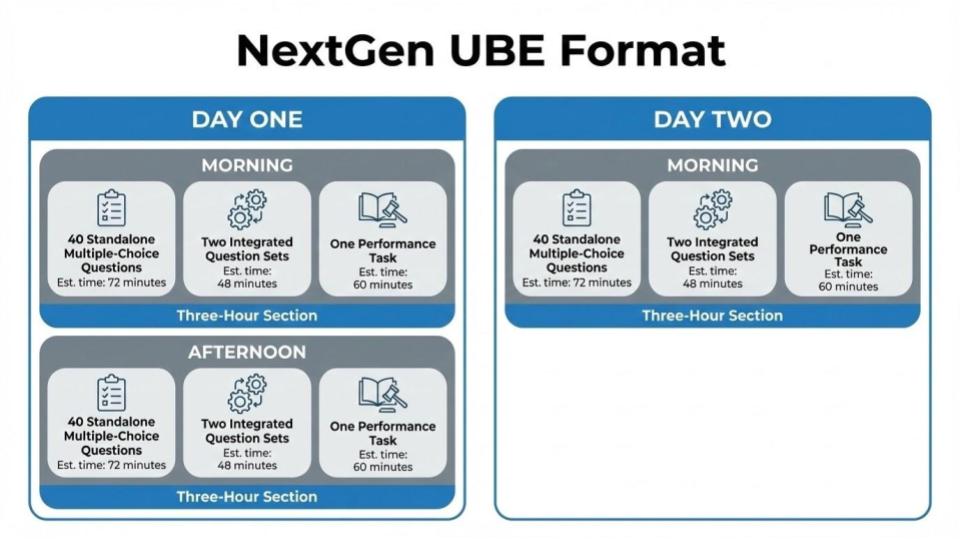
As you can see, each question type, MBE, MEE, and MPT, is tested in separate blocks.[37] However, the NextGen Bar Exam moves away from this structure by presenting all of the question types together in a single session.[38]
The NextGen Bar Exam will be administered over three 3-hour sessions, which means this new exam is a half-day shorter than the current UBE.[39] Each session will contain, in the order bulleted below, the following:
- 40 standalone multiple-choice questions;
- 2 integrated question sets; and
- 1 performance task.[40]
Figure 2
However, before those of us who have already suffered through a bar exam get too jealous of NextGen examinees, let’s further explore changes to the question types.[41] All three of these question types and subtypes, will be discussed in turn below.[42]
i. Standalone Multiple-Choice Questions.
The majority of the standalone multiple-choice questions mimic the questions that currently appear on the MBE.[43] Examinees are asked to make a legal determination based on a given fact pattern and then choose one correct answer from four provided options.[44] However, examinees will also encounter a new type of multiple-choice question that will require examinees to choose two correct answers from six provided options, partial credit is available for these questions.[45] Multiple-choice questions also may test more than one subject.[46] For example, a question could ask how to object to a certain piece of evidence, with options based on both the Federal Rules of Evidence and the Federal Rules of Civil Procedure.[47]
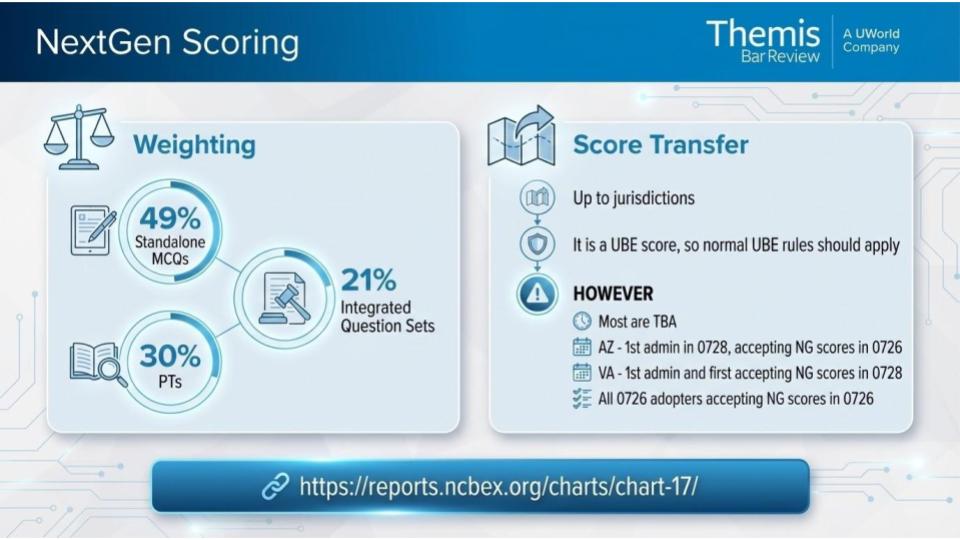
Furthermore, the NCBE estimates an average of 1.8 minutes per standalone question, just like on the current MBE, which accounts for 72 minutes of each three-hour session.[48] Accordingly, standalone multiple-choice questions make up 49% of the total exam score.[49]
ii. Integrated Question Sets.
Integrated question sets replace traditional essays on the NextGen Bar Exam.[50] This brand new question type places examinees in the shoes of a first-year practicing attorney.[51] Examinees are presented with a series of questions that arise from one evolving factual scenario along with legal documents such as client interview notes, deposition transcripts, police reports, or written correspondence.[52] Legal resources (e.g., statutes, caselaw) may also be provided.[53]
There are two types of integrated question sets: counseling types and drafting types.[54] Counseling-type question sets are composed of six questions, two of which are multiple-choice questions, and four of which are short-answer questions.[55] The multiple-choice questions could have four or six answer choices.[56] Unlike a traditional essay, which requires a multi-paragraph response, the short answer questions could range from a single phrase to a few sentences.[57] In these questions, examinees are asked to help a client navigate some legal issue such as recommending claims to bring, identifying next steps to fully analyze the case, or attempting to negotiate a resolution, all while navigating ethical issues.[58] These sets will move between subjects, perhaps beginning with a contractual issue, but then testing procedural or evidentiary issues as the scenario progresses.[59]
Drafting type question sets will present examinees with an excerpt of a legal document, such as a complaint or a contract, alongside client goals and legal limitations.[60] Examinees are then asked to revise that excerpt to achieve those goals.[61] There may also be preliminary questions to answer prior to revisions, such as identifying problems with the document as drafted and the reasons why they are problematic.[62]
The NCBE anticipates that examinees will spend about 24 minutes on each integrated question set.[63] Because two integrated question sets will appear in each three-hour session of the NextGen Bar Exam, examinees will confront a total of six integrated question sets.[64] Combined, the six integrated question sets are worth 21% of an examinee’s total score.[65]
iii. Performance Tasks.
Finally, performance tasks are meant to assess whether examinees can apply foundational lawyering skills in realistic scenarios.[66] For example, examinees will be given an instruction memo from a partner at a law firm or a judge, a file of documents with the facts of the case (e.g., client interviews, emails, transcripts), and a legal library made up of cases, statutes, and other legal authorities.[67] This part of the exam is a “closed universe,” meaning everything needed to draft the answer can be found within the provided documents.[68] As a result, a performance task can test on any legal subject, not just the subjects listed in the NextGen Content Scope Outline, as discussed in the next section.[69] There are, however, two different types of performance tasks, one that is similar to the largely beloved MPT, the standard task, and another that brings a unique twist to this old favorite, the legal research task.[70]
Standard performance tasks are essentially a shorter version of the current MPT.[71] Examinees have 60 minutes to complete a NextGen performance task, which is 30 minutes less than the 90 minutes students have to answer an MPT.[72] Performance tasks should be similar to assignments examinees may have encountered in their legal writing courses or law school internships.[73] However, standard performance tasks require examinees to review the materials provided and complete the writing assignment (e.g., legal brief, objective memorandum, client email) set forth in the instruction memo.[74]
The NextGen Bar Exam also includes a new question type, legal research performance tasks.[75] These performance tasks similarly include an instruction memo, file, and library.[76] However, these materials are followed by a series of multiple-choice and short-answer questions that examinees must answer before completing the writing assignment.[77] The series of questions and writing assignment must also be completed within 60 minutes, which means that the writing assignment will be shorter than what examinees need to draft for a standard performance task.[78] That is why the NCBE refers to the writing assignment for legal research performance tasks as a medium-answer response, while the assignment for a standard performance task is referred to as a long-answer response.[79]
One performance test will appear in each three-hour session of the NextGen Bar Exam, so examinees will confront a total of three performance tasks.[80] Combined, the three performance tasks are worth 30% of an examinee’s total score.[81]
These three question types—standalone multiple-choice questions, integrated question sets, and performance tasks—collectively test the foundational subjects and skills listed in NextGen Bar Exam Content Scope Outline, which is discussed in greater detail below.[82]
B. Testable Content: Foundational Subjects and Foundational Skills.
Upon its launch, the NextGen Bar Exam will test an examinee’s foundational knowledge of eight subjects: Business Associations plus the seven subjects tested on the MBE (Civil Procedure, Constitutional Law, Contracts, Criminal Law and Procedure, Evidence, Real Property, and Torts).[83] This means that NextGen examinees are charged with demonstrating sufficient substantive knowledge of four fewer subjects than those taking the current Maryland Bar Exam, the UBE.[84] That is because Conflict of Laws, Family Law, Secured Transactions, and Trusts and Estates have been removed from the list of foundational subjects upon launch of the new exam.[85] This should be a big sigh of relief for those slated to take the NextGen Bar Exam.[86]
It gets better; The NextGen Content Scope Outline, which is developed by the NCBE, lists the testable topics within each foundational subject and identifies whether each topic is starred or unstarred.[87] Starred topics require examinees to rely purely on memorization to approach questions, while unstarred topics may be tested with the provision of legal resources.[88] The effect is that certain subtopics (and topics within each subject) will be tested in greater depth than others.[89] While examinees are still charged with memorization, in some instances, examinees may be provided with statutes, caselaw, and other legal resources to apply to the facts.[90] This structure seeks to reduce the number of complex rules that examinees need to remember, thereby deemphasizing the need for memorization when evaluating an examinee’s legal reasoning and analysis skills.[91]
Although students need only have preexisting substantive knowledge of the eight foundational subjects listed above on exam day, examinees will encounter additional subjects on their performance tasks.[92] However, they are not expected to have a preexisting knowledge base of blackletter law in these areas.[93] These additional subjects will appear on the exam for the purpose of testing foundational skills only (i.e., “legal research, legal writing, issue spotting and analysis, investigation and evaluation, client counseling and advising, negotiation and dispute resolution, client relationship and management.”)[94] This means legal resources such as statutes and cases will be provided to help examinees answer those questions.[95]
From 2026 to 2028, Family Law, as well as Trusts and Estates, will appear on every exam as “prioritized subjects” to test foundational skills without testing foundational legal knowledge.[96] This means students will likely encounter these subjects on performance tasks, where no preexisting substantive knowledge of these subjects is required, or in integrated question sets, but with the provision of legal resources to address the issues.[97] However, in July 2028, Family Law will be added to the list of foundational subjects in the NextGen Content Scope Outline.[98] This means Family Law can then be tested in any question type, because examinees will be expected to have a preexisting knowledge base of blackletter Family Law.[99]
Although NextGen examinees will reap the benefits of fewer foundational subjects and less memorization, they will have to confront brand new question types—multiple-choice questions with six answer options, integrated question sets, legal research performance tasks (discussed above)—that test foundational lawyering skills by placing examinees in the shoes of a newly licensed attorney.[100] Additionally, these foundational subjects and foundational skills can be tested in any question type.[101] This differs from the current Maryland Bar Exam, the UBE, which tests certain subjects on certain components of the exam (e.g., Family Law is tested only on the essay component of the current exam).[102]
Though these changes to the format and scope of the exam seem extreme at first glance, such as less memorization and no essays, the focus on skills combined with the access to materials while answering questions, may more accurately assess an examinee’s ability to competently represent clients than the traditional bar exam format.[103]
III. Conclusion.
Adoption of the NextGen Bar Exam has not been without controversy.[104] New question formats, the testing of skills, and a perceived dearth of released sample questions have some uncomfortable with the change.[105] Still others believe the new exam is not different enough from the current UBE, and many jurisdictions are redoubling their efforts to develop alternative paths to licensure.[106] While educators are rightly apprehensive about preparing students for a brand new bar exam, the NextGen Bar Exam could spark ideas of how to engage a new generation of law students in different ways.[107] Incorporating legal documents into the classroom, cross-curricular development, and practice-focused assessments more accurately reflect the tasks newly licensed lawyers perform, while having the added benefit of preparing students for the NextGen exam.[108] Time will tell whether the NextGen Bar Exam brings the desired changes to law school curriculum and attorney licensure.[109] Stay tuned!


[1] Sophie Dye Gayle and Stephanie Acosta are Directors of Legal Education at Themis Bar Review | UWorld, LLC, where they lead the development of innovative educational materials designed to help students succeed in law school and on the bar exam, including the NextGen Bar Exam. Sophie earned her J.D. from Loyola University Chicago School of Law and holds a B.A. in English Language and History from Loyola University New Orleans. Stephanie earned her J.D. from St. Mary’s University School of Law, where she continues to serve as an Assistant Moot Court Coach, and holds a B.A. in Anthropology from the University of Arizona.
[2] See Next Gen UBE, Nat’l Conf. of Bar Exam’r, https://www.ncbex.org/exams/nextgen (on file with the University of Baltimore Law Forum) (last visited Feb. 4, 2026) [hereinafter Next Gen UBE].
[3] See infra Part II.
[4] See infra Part I.
[5] NCBE Testing Milestones, Nat’l Conf. of Bar Exam’r, https://nextgenbarexam.ncbex.org/wp-content/uploads/NCBE-Testing-Program-Timeline.pdf (on file with the University of Baltimore Law Forum) (last visited Jan. 12, 2026).
[6] See infra Part III.
[7] See Next Gen UBE, supra note 2 (providing access to the NextGen UBE exam software preview).
[8] See infra Part I.
[9] See infra Part II.
[10] See State Board of Law Examiners: Origin & Functions, Md. Manual On-Line (July 10, 1998), https://1998mdmanual.msa.maryland.gov/msa/mdmanual/33jud/html/05lawf.html (on file with the University of Baltimore Law Forum) [hereinafter State Board of Law Examiners: Origin & Functions].
[11] Id.
[12] See UBE Jurisdictions, Nat’l Conf. of Bar Exam’r, https://www.ncbex.org/exams/ube/list-ube-jurisdictions (on file with the University of Baltimore) (last visited Mar. 9, 2026).
[13] See UBE Score Portability, Nat’l Conf. of Bar Exam’r, https://www.ncbex.org/exams/ube/ube-score-portability (on file with the University of Baltimore) (last visited Mar. 9, 2026).
[14] See id.; Katlin Kiefer, The History of the U.S. Bar Exam, Part I – The Law’s Gatekeeper, Libr. of Congress Blogs (Feb. 13, 2024), https://blogs.loc.gov/law/2024/02/the-history-of-the-u-s-bar-exam-part-i-the-laws-gatekeeper/#:~:text=Most%20written%20exams%20were%20just%20essays%20until,consistent%20test%2C%20the%20Multistate%20Bar%20Examination%20(MBE) (on file with the University of Baltimore Law Forum).
[15] See State Board of Law Examiners: Origin & Functions, supra note 10; Kiefer, supra note 14.
[16] See State Board of Law Examiners: Origin & Functions, supra note 10.
[17] Id.
[18] Celebrating 50 Years of the MBE: A Brief History of the Landmark Examination, 91 The Bar Exam’r 7 (2022).
[19] See id.
[20] Id.
[21] Id.
[22] Id.
[23] See Jurisdictions, Nat’l Conf. of Bar Exam’r, https://www.ncbex.org/jurisdictions (on file with the University of Baltimore Law Forum) (last visited Jan. 19, 2026) [hereinafter Jurisdictions]. For example, California, Delaware, Florida, Georgia, Hawaii, Louisianna, Mississippi, Nevada, South Dakota, Virginia, Wisconsin, Guam, Northern Mariana Islands, Palau, and Puerto Rico draft at least one component of their bar exam. Id. UBE jurisdictions are also able to set their own minimum passing score. See UBE Minimum Scores, Nat’l Conf. of Bar Exam’r, https://www.ncbex.org/exams/ube/ube-minimum-scores (on file with the University of Baltimore Law Forum) (last visited Feb. 16, 2026).
[24] Diane F. Bosse, A Uniform Bar Examination: The Journey From Idea to Tipping Point, 85 The Bar Exam’r 19 (Sept. 2016).
[25] Id.
[26] Id.
[27] State Board of Law Examiners, About the NextGen UBE in Maryland, Md. Ct., https://www.mdcourts.gov/ble/nextgenube (on file with the University of Baltimore Law Forum) (last visited Jan. 19, 2026).
[28] Jurisdictions, supra note 23.
[29] NextGen UBE: Jurisdictions That Have Adopted the NextGen UBE, Nat’l Conf. of Bar Exam’r, https://www.ncbex.org/exams/nextgen (on file with the University of Baltimore Law Forum) (last visited Jan. 19, 2026).
[30] Id.Maryland will be alongside Connecticut, Guam, Idaho, Missouri, Northern Mariana Islands, Oregon, Palau, Virgin Islands, and Washington. Id.
[31] Final Report of the Testing Task Force, Nat’l Conf. of Bar Exam’r (2021), https://nextgenbarexam.ncbex.org/reports/final-report-of-the-ttf/ (on file with the University of Baltimore Law Forum).
[32] Id. See generally NextGen UBE Bar Exam Content Scope Outline: July 2026–February 2027, Nat’l Conf. of Bar Exam’r (Aug. 1, 2025), https://www.ncbex.org/sites/default/files/2025-07/NCBE%20NextGen%20UBE%20Content%20Scope-Aug%202025.pdf (on file with the University of Baltimore Law Forum) [hereinafter NextGen UBE Bar Exam Content Scope Outline: July 2026–February 2027] (explaining the NCBE’s intentions on the format of the exam in regards how it’s used for testing).
[33] About the NextGen UBE, Nat’l Conf. of Bar Exam’r, https://www.ncbex.org/exams/nextgen/about-nextgen (on file with the University of Baltimore Law Forum) (last visited Jan. 19, 2026) [hereinafter About the NextGen UBE].
[34] See infra Sections II.A-B.
[35] See infra Sections II.A-B.
[36] See infra Sections II.A-B; see, e.g., infra Figure 1.
[37] See infra Sections II.A-B.
[38] NextGen UBE Blueprint: July 2026–February 2027, Nat’l Conf. of Bar Exam’r 1 (June 2, 2025), https://www.ncbex.org/sites/default/files/2025-07/NCBE-NextGen-UBE-Blueprint_5.pdf (on file with the University of Baltimore Law Forum) [hereinafter NextGen UBE Blueprint: July 2026–February 2027].
[39] Id.
[40] Id.; see, e.g., infra Figure 2 (citing NextGen Bar Exam Jurisdictions—Date of First Administration, Acceptance of Transferred Scores, and Jurisdiction-Specific Components, Nat’l Conf. of Bar Exam’r, https://reports.ncbex.org/charts/chart-17/ (on file with the University of Baltimore Law Forum) (last visited Mar. 15, 2026).
[41] See infra Section II.B.
[42] See infra Section II.B.i-iii.
[43] See supra Part I; infra Section II.B.; discussion infra notes 48-49.
[44] NextGen UBE Blueprint: July 2026–February 2027, supra note 38,at 2.
[45] Id. at 2, 7.
[46] Id.
[47] See id.
[48] Id. at 1.
[49] Id. at 7.
[50] Compare NextGen UBE Blueprint: July 2026–February 2027, supra note 38,at 2–3 (listing multiple choice, integrated question sets, and performance tasks as NextGen question types), with Uniform Bar Exam, Nat’l Conf. of Bar Exam’r, https://www.ncbex.org/exams/ube (on file with the University of Baltimore Law Forum) (last visited Jan. 19, 2026) (listing multiple choice, essays, and performance tasks as question types).
[51] E.g., Sample NextGen UBE Integrated Question Sets, Nat’l Conf. of Bar Exam’r, https://www.ncbex.org/exams/nextgen/sample-questions/integrated-question-sets (on file with the University of Baltimore Law Forum) (last visited Jan. 19, 2026) [hereinafter Sample NextGen UBE Integrated Question Sets].
[52] See id.; NextGen UBE Blueprint: July 2026–February 2027, supra note 38, at 2.
[53] NextGen UBE Blueprint: July 2026–February 2027, supra note 38, at 2.
[54] Id. at 7.
[55] Id.; e.g., Sample NextGen UBE Integrated Question Sets, supra note 51.
[56] NextGen UBE Blueprint: July 2026–February 2027, supra note 38, at 7; e.g., Sample NextGen UBE Integrated Question Sets, supra note 51.
[57] NextGen UBE Blueprint: July 2026–February 2027, supra note 38, at 7; e.g., Sample NextGen UBE Integrated Question Sets, supra note 51.
[58] NextGen UBE Blueprint: July 2026–February 2027, supra note 38, at 7; see e.g., Sample NextGen UBE Integrated Question Sets, supra note 51.
[59] Sample NextGen UBE Integrated Question Sets, supra note 51; see NextGen UBE Blueprint: July 2026–February 2027, supra note 38, at 7.
[60] E.g., Sample NextGen UBE Integrated Question Sets, supra note 51.
[61] Id.
[62] Id.
[63] NextGen UBE Blueprint: July 2026–February 2027, supra note 38, at 1.
[64] Id.
[65] Id. at 7.
[66] NextGen UBE Sample Questions, Nat’l Conf. of Bar Exam’r, https://www.ncbex.org/exams/nextgen/sample-questions (on file with the University of Baltimore Law Forum) (last visited Jan. 19, 2026).
[67] Id.; e.g., NextGen UBE Performance Tasks, Nat’l Conf. of Bar Exam’r, https://www.ncbex.org/exams/nextgen/sample-questions/performance-task (on file with the University of Baltimore Law Forum) (last visited Jan. 19, 2026) [hereinafter NextGen UBE Performance Tasks].
[68] NextGen UBE Performance Tasks, supra note 67.
[69] See id.
[70] NextGen UBE Blueprint: July 2026–February 2027, supra note 38, at 3.
[71] Compare NextGen UBE Performance Tasks, supra note 67 (explaining that NextGen performance tasks test legal research and analysis skills in a closed-universe environment in a 60-minute time period), with Preparing for the MPT, Nat’l Conf. of Bar Exam’r, https://www.ncbex.org/exams/mpt/preparing-mpt (on file with the University of Baltimore Law Forum) (last visited Jan. 19, 2026) [hereinafter Preparing for the MPT] (explaining that the MPT tests legal research and analysis skills in a closed-universe environment in a 90-minute time period).
[72] Compare NextGen UBE Performance Tasks, supra note 67 (explaining that NextGen performance tasks test legal research and analysis skills in a closed-universe environment in a 60-minute time period), with Preparing for the MPT, supra note 71 (explaining that the MPT tests legal research and analysis skills in a closed-universe environment in a 90-minute time period).
[73] NextGen UBE Performance Tasks, supra note 67 (providing examples of NextGen performance tasks and explaining that the tasks will requires examinees to “engage in legal analysis about a client matter and produce a written product, which may be a portion of a memo, brief, or other common legal document”).
[74] Id.
[75] Id.
[76] E.g., Sample NextGen UBE Legal Research Performance Tasks, Nat’l Conf. of Bar Exam’r, https://www.ncbex.org/exams/nextgen/sample-questions/performance-task/sample-research-pt (on file with the University of Baltimore Law Forum) (last visited Jan. 19, 2026).
[77] Id.
[78] NextGen UBE Blueprint: July 2026–February 2027, supra note 38, at 3.
[79] Id.
[80] Id.
[81] Id. at 7.
[82] Id.
[83] NextGen UBE Bar Exam Content Scope Outline: July 2026–February 2027, supra note 32, at 6-42.
[84] Understanding the Uniform Bar Examination, Nat’l Conf. of Bar Exam’r (2022), https://www.ncbex.org/sites/default/files/2023-01/Understanding_the_UBE_2022.pdf (on file with the University of Baltimore Law Forum).
[85] Compare id. (listing Conflict of Laws, Family Law, Secured Transactions, and Trusts and Estates as testable subjects on the UBE), with NextGen UBE Bar Exam Content Scope Outline: July 2026–February 2027, supra note 32, at 6-42 (excluding Conflict of Laws, Family Law, Secured Transactions, and Trusts and Estates from the list of as testable subjects on the NextGen Bar Exam).
[86] See generally NextGen UBE Bar Exam Content Scope Outline: July 2026–February 2027, supra note 32 (explaining the NCBE’s intentions on the format of the exam in regards how it’s used for testing).
[87] Id.
[88] Id.
[89] See id. (demonstrating that within the Formation of Contracts topic in the subject of Contracts and Sales, modification of contracts at common law is starred, meaning an examinee will need to rely only on recalled knowledge to answer questions about this subtopic, which modification of contracts under the UCC is unstarred, meaning examinees will be tested on the concept only broadly, or else with the provision of a legal resource).
[90] Id.
[91] See id.
[92] NextGen UBE Content, Nat’l Conf. of Bar Exam’r, https://www.ncbex.org/exams/nextgen/content-scope (on file with the University of Baltimore Law Forum) (last visited Jan. 19, 2026).
[93] Id.
[94] Id.
[95] Id.
[96] Id.
[97] Id.
[98] NextGen UBE Bar Exam Content Scope Outline: July 2026–February 2027, supra note 32, at 3.
[99] Id.
[100] See id.
[101] Id.
[102] About the NextGen UBE, supra note 33.
[103] See supra Part II.
[104] See Statements: AASE Raises Serious Concerns About NextGen Prototype Questions, Ass’n of Acad. Support Educators (Sept. 6, 2023), https://aaselaw.org/page/statements#nexgen (on file with the University of Baltimore Law Forum) [hereinafter Statements: AASE Raises Serious Concerns About NextGen Prototype Questions]; Statements: Scattershot Rollout of NextGen Exam May Exacerbate Disparate Bar Pass Outcomes, Ass’n of Acad. Support Educators (July 9, 2024), https://aaselaw.org/page/statements#scattershot (on file with the University of Baltimore Law Forum) [hereinafter Statements: Scattershot Rollout of NextGen Exam May Exacerbate Disparate Bar Pass Outcomes]. See generally Nachman N. Gutowski et al., Questioning the Inevitability of the NextGen Bar Examination, SSRN (Aug. 2024), https://ssrn.com/abstract=4905722 (on file with the University of Baltimore Law Forum) (identifying concerns that NextGen may cause if NCBE does not address them).
[105] See Statements: AASE Raises Serious Concerns About NextGen Prototype Questions, supra note 104; Statements: Scattershot Rollout of NextGen Exam May Exacerbate Disparate Bar Pass Outcomes, supra note 104. See generally Gutowski, supra note 104 (identifying concerns that NextGen may cause if NCBE does not address them).
[106] See Julianne Hill, ABA Gives Its Blessing to Alternative Licensing, Am. Bar Ass’n (May 2024), abajournal.com/web/article/aba-legal-ed-council-gives-blessing-to-alternative-licensing (on file with the University of Baltimore Law Forum); Karen Sloan, States Should Consider Bar Exam Alternatives, Chief Justices Say, Reuters (July 30, 2025), https://www.reuters.com/legal/government/states-should-consider-bar-exam-alternatives-chief-justices-say-2025-07-30/ (on file with the University of Baltimore Law Forum).
[107] See supra Part II.
[108] See supra Part II.
[109] See supra Part II.
 ublawforum.com
Leave a comment