
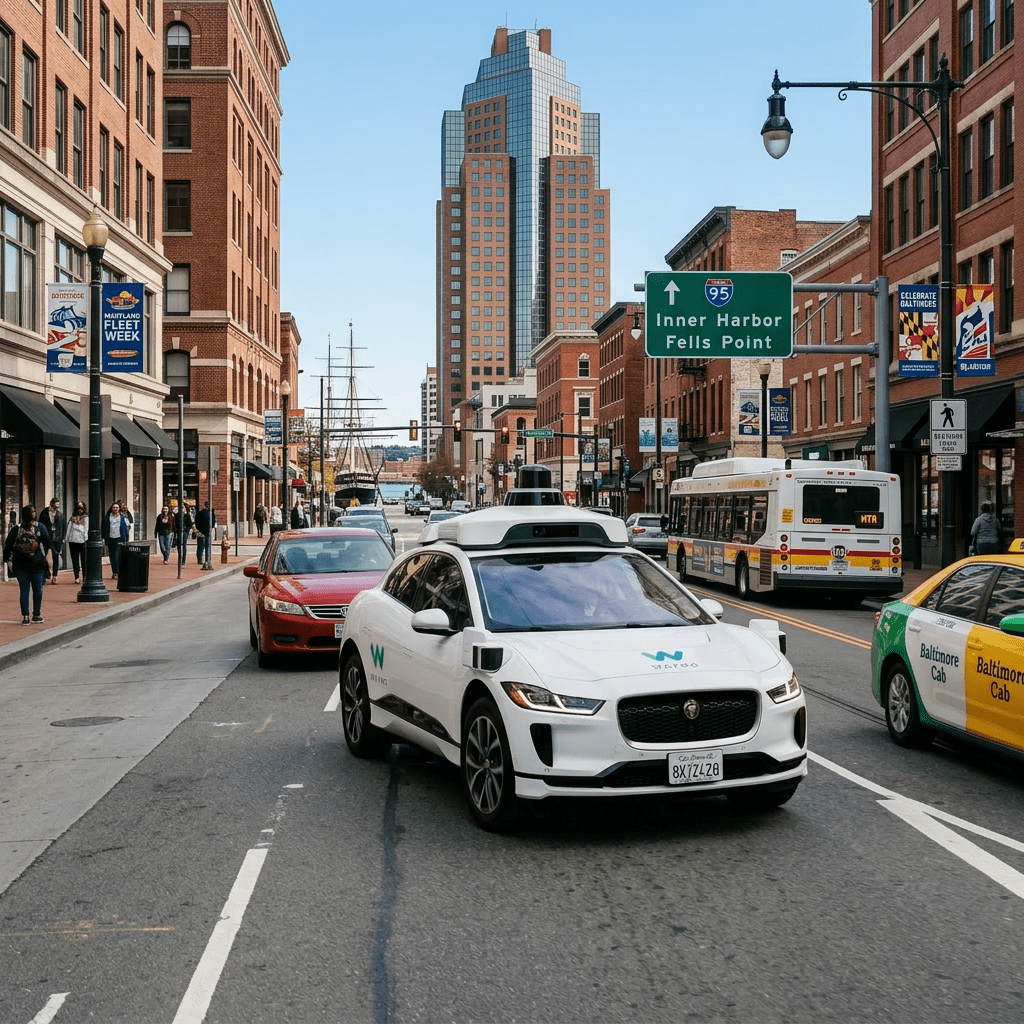
Maryland, like other states throughout the nation, is faced with a new challenge in the form of Autonomous Vehicle (“AV”) technology.[1] Commonly referred to as “driverless” vehicles, this new method of transportation comes with a slew of practical concerns.[2] Like other states before it, Maryland’s legislature has proposed a bill focused on the regulation of AVs.[3] However, the bill, which would take effect on October 1, 2026, if passed in its current iteration, leaves open the significant risk that Maryland citizens may not be able to recover damages resulting from accidents involving AVs.[4]
Waymo, a prominent AV taxi service, has begun rolling out its services in Baltimore through its partnership with Governor Wes Moore, a move that has brought both optimism and concern among Maryland policy makers.[5] Proponents of the expansion to Maryland emphasize that implementation of AVs offers a new way for Marylanders to seek opportunities – especially those for whom traditional transportation systems have failed.[6] In particular, blind people stand to benefit from AVs, according to Mark Roccobono, president of the National Federation of the Blind.[7] Additionally, Delegate Ziegler, the sponsor of the proposed AV bill, advocates for the advantages autonomous cars would have over human drivers – namely, that “they don’t drink, speed, or text while driving.” [8]
While the potential upside of AVs is notable, House Bill 1295 has flaws that critics say would leave Marylanders in difficult positions.[9] First, the bill as written lacks a method of imposing accountability for crashes or traffic infractions.[10] Because the bill defines the “operator” of an AV as its “automated driving system,” there is no responsible legal actor to bring a claim against when accidents occur and its present form, liability would not be attributed to the company or person operating the AV.[11] The same holds true for traffic tickets; as it stands, should an AV break a traffic law, there is no party to whom an officer could issue a citation to.[12]
In addition to the legal confusion House Bill 1295 would cause, there are consequences for Marylanders even in the event that things don’t go wrong. [13] A successful rollout of AV ride services would mean a significant reduction in opportunities for gig workers like Uber drivers.[14] The potential burden of allowing AVs on the road is then once again shifted away from the companies that operate these services, and placed onto the backs of Marylanders who can least tolerate a reduction in income.[15] While AVs may be the vehicles of the future, as is often the case with new technology, when regulations are implemented without a thorough understanding of the impact on all stakeholders, it is often the common person who loses. House Bill 1295 risks the wellbeing of Maryland citizens in favor of early adoption.

Dillan Moore is a third-year student at the University of Baltimore School of Law and serves as an Associate Editor for Law Forum. He earned his bachelor’s degree in Psychology with a minor in Biology from the University of Nevada, Reno. Dillan is currently a Law Clerk at Azrael, Franz, Schwab, Lipowitz, & Solter in Towson. After graduation, Dillan plans to return to his hometown of Reno to represent small business owners in his community.
[1] See Ian Round, MD bill allowing driverless cars faces opposition over crash liability, The Daily Rec. (Mar. 12, 2025), https://thedailyrecord.com/2026/03/12/maryland-driverless-cars-liability-bill/ (on file with the University of Baltimore Law Forum).
[2] See id. (listing crash liability, vehicle malfunctions, and job loss as examples of potential downsides of AVs.)
[3] H.B. 1295, Gen. Assembly Reg. Sess. (Md. 2025); see Autonomous Vehicle Statutes and Regulations Across the 50 States, Baker Donelson (Sept. 20, 2024), https://www.bakerdonelson.com/autonomous-vehicle-statutes-and-regulations-across-the-50-states (on file with the University of Baltimore Law Forum).
[4] Round, supra note 1.
[5] Waymo, a self-driving car service, expands to Baltimore, The Daily Rec. (Dec. 3, 2025), https://thedailyrecord.com/2025/12/03/waymo-a-self-driving-car-service-expands-to-baltimore/ (on file with the University of Baltimore Law Forum).
[6] Id.
[7] Id; see also Rhiannon Evans, Lots of questions, but little pushback at Senate hearing on bill to allow driverless cars, Md, matters (Mar. 4, 2026 at 10:42 ET), https://marylandmatters.org/2026/03/04/lots-of-questions-but-little-pushback-at-senate-hearing-on-bill-to-allow-driverless-cars/ (on file with the University of Baltimore Law Forum).
[8] Round, supra note 1; see also Evans, supra note 7 (“Waymo’s can’t ‘drive inebriated, chew edibles, drive distracted, or speed’”).
[9] Id.
[10] Id.;H.B. 1295, Gen. Assembly Reg. Sess. (Md. 2025).
[11] Round, supra note 1.
[12] Id.
[13] Id.
[14] Id.
[15] Id.


Leave a comment